Once I had broken the news to Phyllis and explained to the kids why we were not going to Bloemfontein anymore, but to Welkom in the Orange Free State, we did some hasty research, as it was not a place either of us had ever heard of. We established that it was a flourishing gold mine town that had obtained city status when it was just 21-years old. We were instantly keen to go and visit.
Johannesburg has always been known as the city of gold but in recent years it had been discovered that Welkom had significantly more gold reserves underground. Just one mine shaft produced 12 % of the world’s gold. Companies from all over the world were flocking to this town and under the leadership of Sir Ernest Oppenheimer and Anglo American a miracle city was being created.
Welkom originated in the late 1940s as a meticulously planned company town to support a massive gold rush. After a rich gold reef was discovered in the Free State in 1946, Anglo American officially founded the town in 1947 on a farm named Welkom.
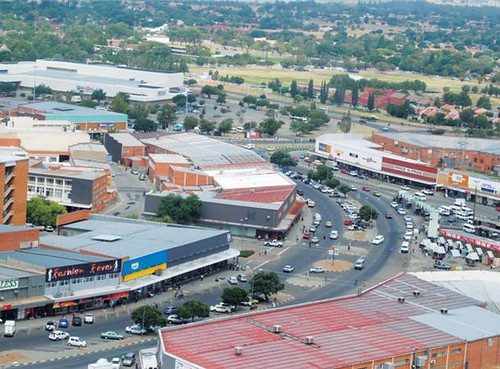
Unlike the typical, chaotic “tent towns” common in historical gold rushes, Welkom was carefully designed from scratch as a model town. It featured broad boulevards and residential neighborhoods built around commercial hubs to minimize travel and foster easy commutes.
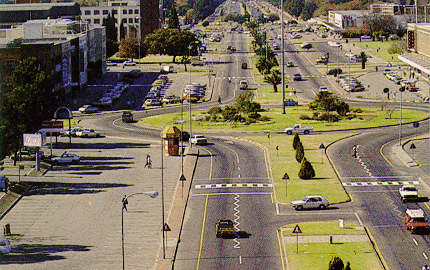
Because it was built with traffic flow in mind, the city planners utilized a large number of traffic circles and roundabouts rather than traditional intersections. It contains over 30 major traffic circles, giving Welkom its famous nickname of “Circle City”.
Under the direction of Ernest Oppenheimer, city developers planted over a million trees to beautify the area, earning it the reputation of being a lush, green city in the heart of the Free State goldfields.
Because of the highly productive gold and uranium mines, Welkom grew at a staggering rate. It was granted municipal status in 1961 and officially declared a city in 1968.
As this was likely to be our home for a number of years and the children would need to attend school, our first task was to go house hunting as soon as possible. A few days after my letter of appointment, I received a welcoming letter from a Mr Henk Kaldenberg who was the head of the Child Guidance Clinic where I would be stationed.
In my reply to him, I mentioned that we planned to go to Welkom before the end of the year to hunt for a home. He offered to fetch us from Bloemfontein (there was no commercial airport in Welkom yet) and that Phyllis and I could stay with them during that time. It was a great opportunity to be able to get to know the Head of the clinic and to learn from them about Welkom and where best to search for a house.
Estate agents were only too keen to take us to different homes that were on the market. We were particularly interested in a house that also had a swimming pool, belonging to a retiring mine captain. We went to see the house and ended up getting on really well with a very friendly couple, Dick and Olga Thomas, who invited us to stay with them for a few days on our next visit, which we accepted. They had a son called Richard who was just a year younger than Nikki.
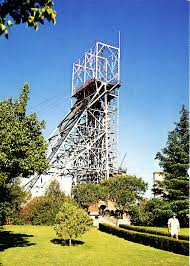
The St Helena mine that Dick worked on was the earliest mine in Welkom and had the unique claim to fame of harbouring an underground wine cellar, located 857 Meters below the earth’s surface. On our second day, they invited us to go down the mine and have a drink there with them. Phyllis and I naturally agreed and accompanied them underground.
Dick offered to take me deeper into the mine where the gold was being dug. I was fascinated to see more, but was not dressed for the occasion. This was not an issue and I was given the correct clothing, overalls, boots and a helmet with a lamp. I found the clothing extremely heavy and not being used to the extreme heat, it became quite difficult to keep up with the group.
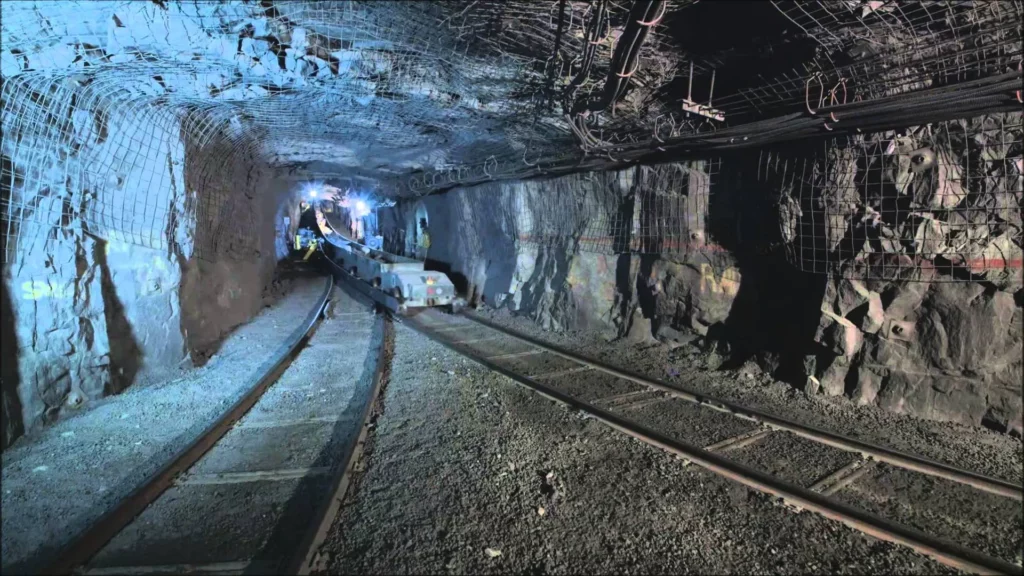
We ventured down to where the gold was being mined and at times, we were crawling through tunnels to see where seams of gold ran along the walls of the rock. I could literally feel my heart being strained and was glad when the excursion ended and even more so that I did not have to work underground in those extreme conditions. Phyl and I agreed that it was a great experience, but the wine could have been better 😉
The estate agent agreed that we could have first option on buying the Thomas’s house and the purchase documents would be mailed to me in Cape Town so that I could manage the financial details and payment with my bank. We left with a feeling of settled happiness and began looking forward to our stay in Welkom.
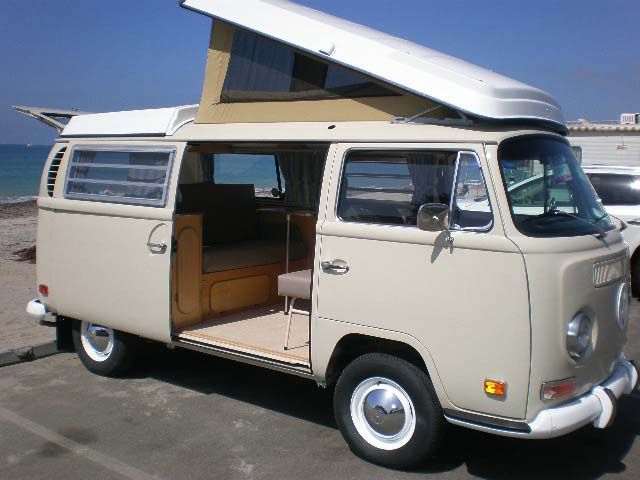
A week went by before a letter arrived to say that the house was no longer available and had in fact been sold. At this late stage we already had our Volkswagen Camper Kombi packed for the long trip to Welkom, and it left us with no option but to go ahead and simply see what we could manage once we got there. On the drive up, we experienced a severe rain deluge and were blocked at the flooding Vaal River, just as we were about to enter the Orange Free State.
Eventually we arrived in Bloemfontein and I suddenly thought of visiting the Education Department to explain our predicament about accommodation in Welkom. I was ushered to the Administrator (my big boss)’s office. When I introduced myself, he said, “You are the chap we fought so hard for to join us in Bloemfontein and now you have already left us.”
However, I obtained permission, at the Education Department’s expense, to stay at any hotel in Welkom for a month. On arrival in Welkom, I asked my connection at Standard Bank to recommend a hotel for our stay, and so, the Hotel 147 became our very first “home”. (These days it is known as the Welkom Inn.)
We tried to get Nikki into the local convent school, St Agnes, but they were taking no new admissions. Aurora Primary School could accommodate both Colin (into Sub A) and Nikki into Standard 5. It was not far from the hotel where we were staying.
My rooms were in the Child Guidance Clinic on the second floor of the medical centre which was located centrally in town. The first few days were spent meeting the psychologists and general staff and getting myself settled in.
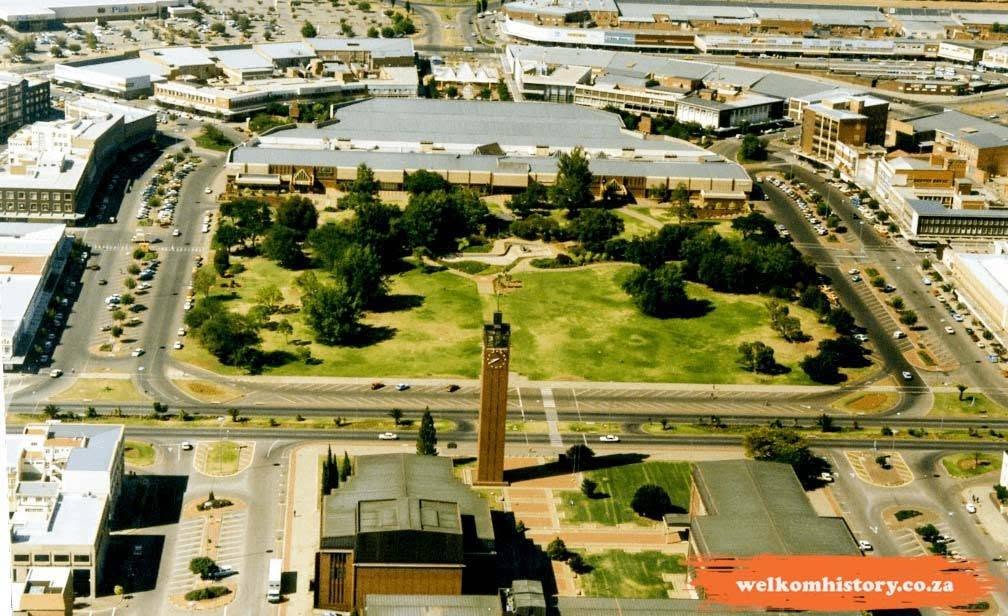
During the second week I was taken to all the schools in the city to meet the Headmasters and familiarise myself with the city layout. That was how I got to understand why Welkom was nicknamed “Circle City”, because instead of stop streets, all intersections flowed smoothly around large traffic circles ensuring little or no time delay in negotiating a change of direction, or waiting at robots.
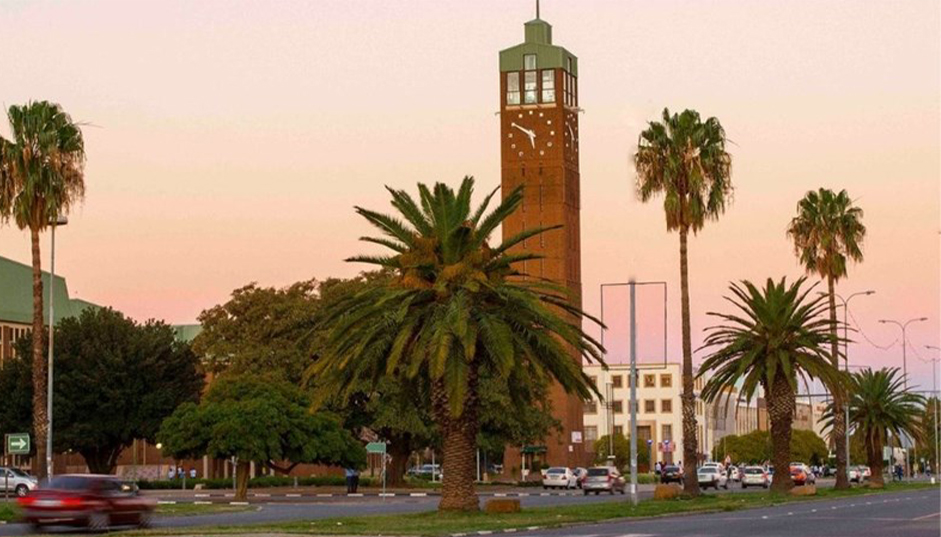
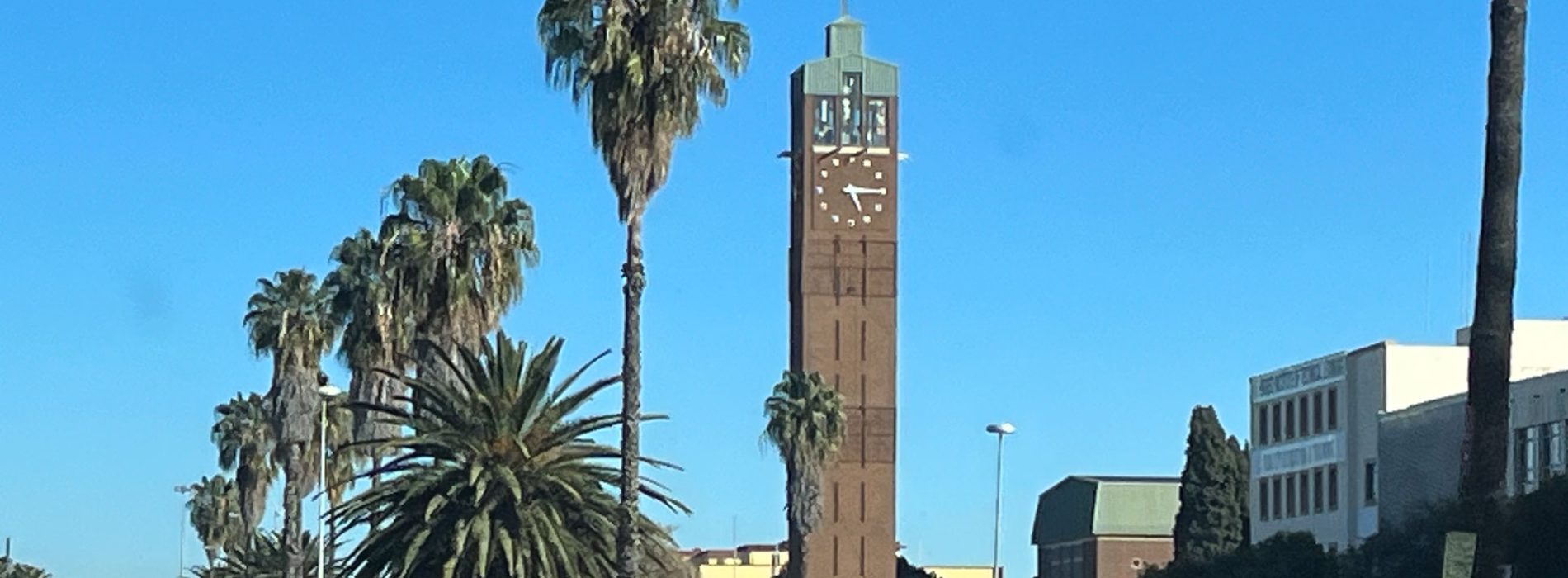
The central business district was arranged in semi-circular design around a lovely green park and positioned opposite the Main Street, Stateway, where the main municipal buildings, theatre and library were located, identified by the iconic clock tower.
In the vicinity of Welkom, there were quite a number of smaller towns with schools that also qualified for a remedial teacher and these would be included as part of my responsibility.
Apart from Welkom there were also clinics in the towns of Sasolberg, Bethlehem, Kroonstad and Bloemfontein. The heads of these clinics invited Phyllis and I to a get together one Friday afternoon and evening so that they could meet us together with their wives and make us feel at home in the Orange Free State.
My next endeavour was to meet all the remedial teachers under my control in the Welkom area and for me to get to know them and to bring them up to speed with my views on remedial teaching. I thought that my talk went well until at teatime I was told that some teachers were in distress and some were even reduced to tears and I should please find out what was upsetting them.
It turned out that although I spoke in Afrikaans, the terminology I used was unfamiliar to some and had caused a certain amount of anxiety. I realised that having worked with the lecturing staff at Stellenbosch I had gotten used to terms that were quite unfamiliar to these teachers. I had to simplify my Afrikaans terminology in future dealings with them. Baby steps.
We enjoyed our stay at the 147, but we only had one free month there. However, chatting to the Regional Manager of Standard Bank, I mentioned that we were having to move and were searching for a permanent home. He said that the bank owned a double story building where the second floor was currently vacant and we could stay there until we found and purchased our house. That was great news and we moved there at the end of our first month in Welkom.
I qualified for a state subsidised motor vehicle, so Phyllis could use our Camper van for shopping and fetching and carrying the children. Since Michael was going to be starting school the following year, Phyllis began searching for a teaching post. She was offered a post at Welkom Primary School by Mr. Barry, the headmaster, and Michael would be able to start at the Welkom Prep school the following year.
The City Council advertised the development of a brand new suburb, very close to the city centre called Jan Cilliers Park. Plots were marked and building plans were available. Although the area was not established with trees and parks like the other older suburbs, we went and chose a plot and a house plan that would suite our requirements, namely three bedrooms, two bathrooms, a double garage and quick access to the centre of the city. Opposite the plot was a vacant area for future city development. I chose number 33 Langenhoven Avenue, and the plan and the builder planned to complete it as soon as possible.
It was exciting to have a brand new home characterised by big windows and an ensuite bathroom, but a brand new suburb also came with challenges. We were surrounded mostly by veld and when the August winds arrived, clouds of red dust would blow through, coating everything in a fine orange powder. When the rainy season began, it turned the surrounding roads into thick cloying mud because many of the roads had still to be tarred.


Around this time I was informed by the Western Cape Education Department that due to the fact that I had accepted a teaching post in the Orange Free State without returning to my old post they regarded it as a breach of contract and as a result I have to repay the university fees they encountered for the year of my study period. My counter argument was that I was still involved with South African children in a unified country but just further away from the Cape.
They persisted with their demands for payment and held me responsible for it on a monthly basis. The Free State was not interested in making the payment on my behalf so my next option was to ask the member of Parliament (who wanted me to join the Nationalist Party). That did the trick and ended their demand for money from me.
Apart from my regular remedial lectures, I had to teach teachers how to do hearing tests at the nearby pharmacy. Retesting IQ tests that were previously done with group testing also became necessary. On an occasion I did a home visit to meet a family living on a farm whose child had a learning problem. During the school holiday I travelled to their farm and decided to pay them a visit. Only the mother was present so I asked her to call her son.
While we were discussing his progress, the radio was playing. When the boy arrived, before greeting me he quickly turned off the music that was playing. I immediately diagnosed his problem. He used to sit in the back of his classroom and the ambient noise in the class meant that he missed much of what the teacher explained. A hearing test and new class seating position followed.
I was in demand as guest speaker on almost a weekly basis. PTA meetings. Political parties. Single mothers’ groups. Nursery schools and more. Some during the day and others in the evenings, ended up occupying a great deal of my time.
In our first year in Welkom, Michael attended a Nursery school, and Phyllis had to drop him off and fetch him each day. After about six months, we received a note that the principal wanted to discuss his behaviour. One afternoon Phyllis and I went to fulfil our appointment taking both boys with us. The teacher said many positive things about Michael and how helpful he was. He was first to do things and always helpful. We finally established that the concern was that he refused to have a nap when the class was required to rest after lunch.
Leaving the meeting we were startled to find that the boys, who had been left outside to play, were missing. I wandered around calling for them and eventually located Colin high up in a tree, and Michael, was on the school roof! The principal was horrified that Michael could have been on the roof. He was clearly not adjusting to the class restrictions, just as he refused to sleep in the middle of the day. An independent and rather stubborn child.
We started our very regular school holiday trips back to our house in Simon’s Town using the Camper. We did this trip three times a year and got to know the route far too well! Later we would take our dog and eventually we needed to tow a trailer. A cat and a mouse were added to our traveling menagerie, as well as a variety of cuddly toys for the kids’ entertainment along the journey. This we kept up for many years without fail.
Welkom has a long history of seismic activity mainly caused by the very deep mining activities. After a while we started getting used to the ground shaking after hearing a distant explosion rumbling in the ground far below. It is particularly disturbing when you wake up in the middle of the night with a loud noise to find your bed shaking. Phyllis would grab hold of me in the dark and it usually took quite a while before she could fall asleep again. After many months of this, we got so used to the tremors that we wouldn’t even flinch…
On the afternoon of the 8th of December 1976, I had completed my tasks for the day and decided to visit a doctor in the floor below my office. Instead of using the lift I walked down the connecting spiral staircase. Halfway down I heard an extremely loud bang and the floor started shaking while bits of plaster broke out from the wall. Expecting it to settle quickly as usual, I began to realise that this was a more severe quake.
I heard women screaming and decided to go upstairs again to see if could be of help. Window glass had shattered and was lying everywhere. People were running out into the street and gathering in anxious groups. I went back to my rooms and looked out the back window where the Post Office and a 6-story block of flats were located.
My next thought was to look after my family. I used my motorbike to dash to Michael’s school to see that all was under control. Then I drove to our house to find it standing and noticed no real damage at that stage. Then I shot off to St Helena Primary school where Phyllis was teaching at the time. The headmaster came to meet me and said that the teachers had been in the staff room when the entire ceiling fell down on them, but without serious injury to anyone.
Nikki was writing exams at the convent. She recalled her pen suddenly moving on the page like a seismograph!
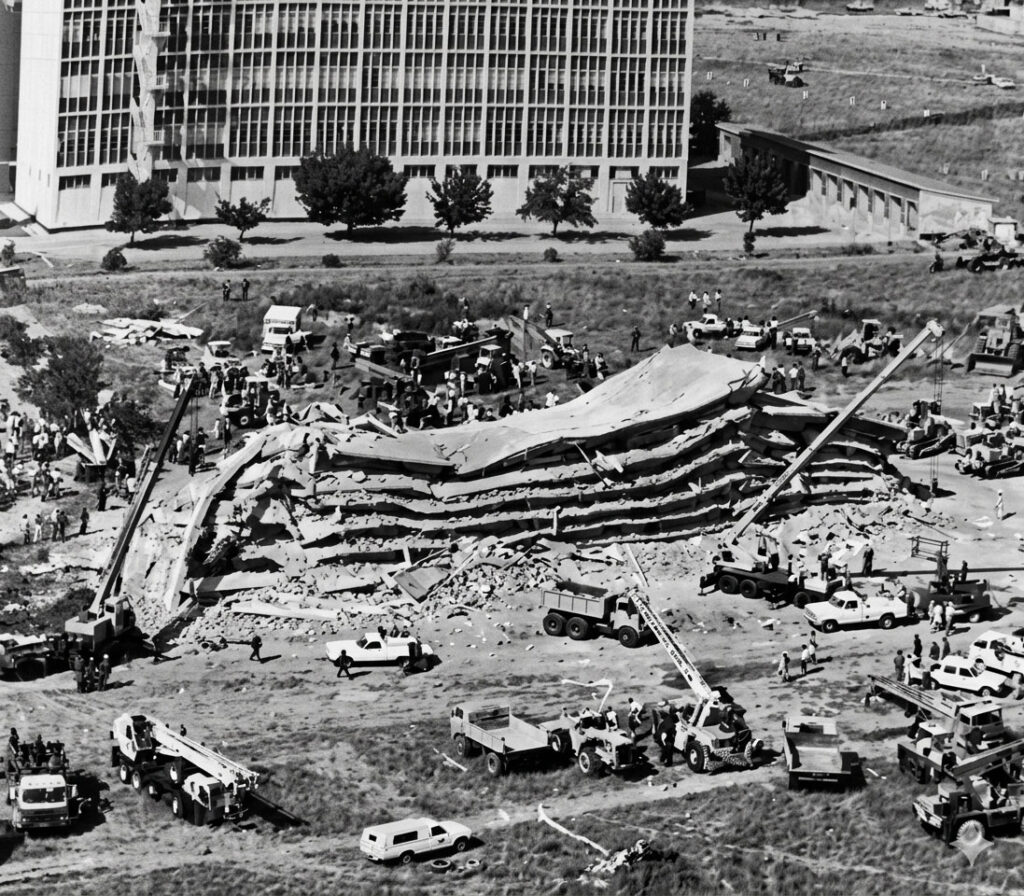
Whilst the two of us were standing in front of the school discussing the quake, a man came and told us that a block of flats had just collapsed, and the mines were sending men and machines to search for survivors. Looking up from where we were standing, a dust cloud rose up from the direction of my office.
It was the block of flats behind my building that had collapsed. It had a parking garage at ground floor and five floors above consisting of residential flats. The caretaker, upon noticing cracks running up the infrastructure of the building and a distinct sway, immediately called residents to evacuate, but nobody knew if they’d gotten everyone out in time. The cars parked below were all flattened and the building looked like a concertina.
Something I will never forget is to see how efficient the miners were in going into narrow openings to search for people, risking their own lives. Cranes and bulldozers were rushed across to help and the speed with which it was done, without orders or panic, made me respect these goldminers a great deal. Only four miners were killed in the collapse of “Tempest Court”, and we found out later that it was a 5.2 magnitude earthquake. What an experience we lived through but thankfully we were safe.
A rather depressing article by Ivo Vegter published in IRR in 2019, blaming Welkom’s decline on BEE policies (only a select few at the top were benefiting), onerous taxes on the mining industry, cronism and corruption.
“Welkom in the Free State offers a blueprint for what happens when mining declines and dies. In the 1960s, Welkom played host to the largest Porsche Club in the country. It was the gold rush town of the era.
Founded only 71 years ago at the heart of the newly discovered Free State gold fields, then the richest in the world, Welkom experienced a dramatic boom. By 1968, only twenty years after its establishment as a greenfields development, it had achieved city status.
Today, it is a town in decay. On most economic indicators, it is the worst-performing urban area in South Africa.
Welkom’s decline began in the 1980s, when the gold seams began to peter out. Thousands of jobs were lost. In 1987, the mining sector in the gold fields region surrounding Welkom employed 184 600 people, representing 67% of the total workforce. By 2010, almost 150 000 jobs had been lost. Only 35,700 jobs (or 42% of the workforce) were left.
The vast majority of the region’s manufacturing sector was linked to mining. Seventy-one percent of that sector’s jobs vanished between 1987 and 2010.
In total, 275 200 people were employed in the Welkom gold fields region in 1987. By 2010, that had declined to a mere 84 700.
The unemployment rate in the Lejweleputswa District Municipality, which has its seat in Welkom, rose from 35% in 1996 to 53% in 2008, and the poverty rate rose from 36% in 1996, which was lower than the provincial average, to 61.3% in 2006.
Businesses closed their doors, commercial rents plummeted, and house prices were lower in 2010 than they were in 2001. Welkom’s economy is in tatters.”