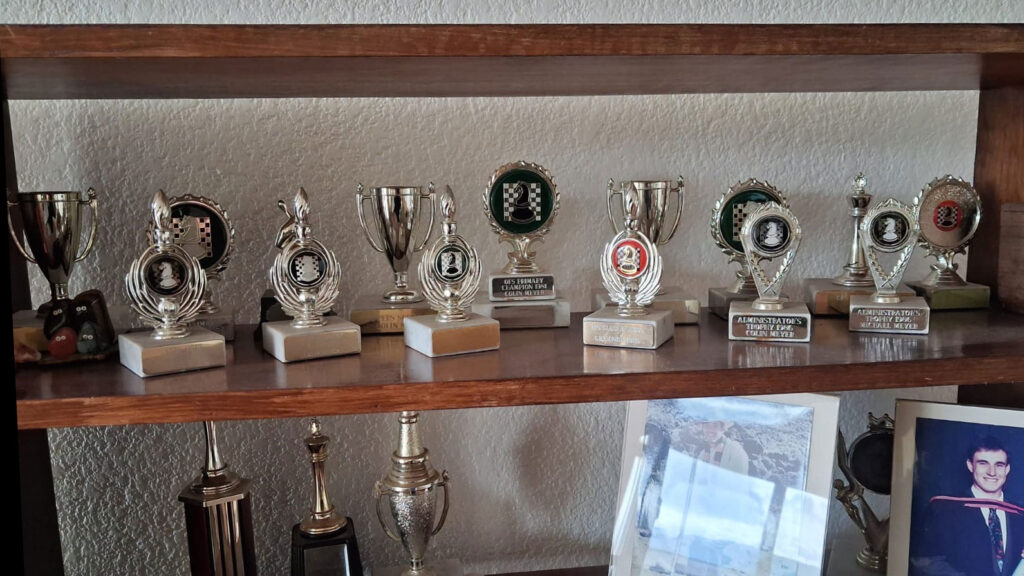
I do not remember when I saw my first chess set or when or where I acquired my own set. New things always interested me, like when I heard about a new universal language that was being spoken by thousands of people. I found a leaflet about Esperanto and immediately started learning and finding opportunities to use it, so I guess that’s what I did with chess.
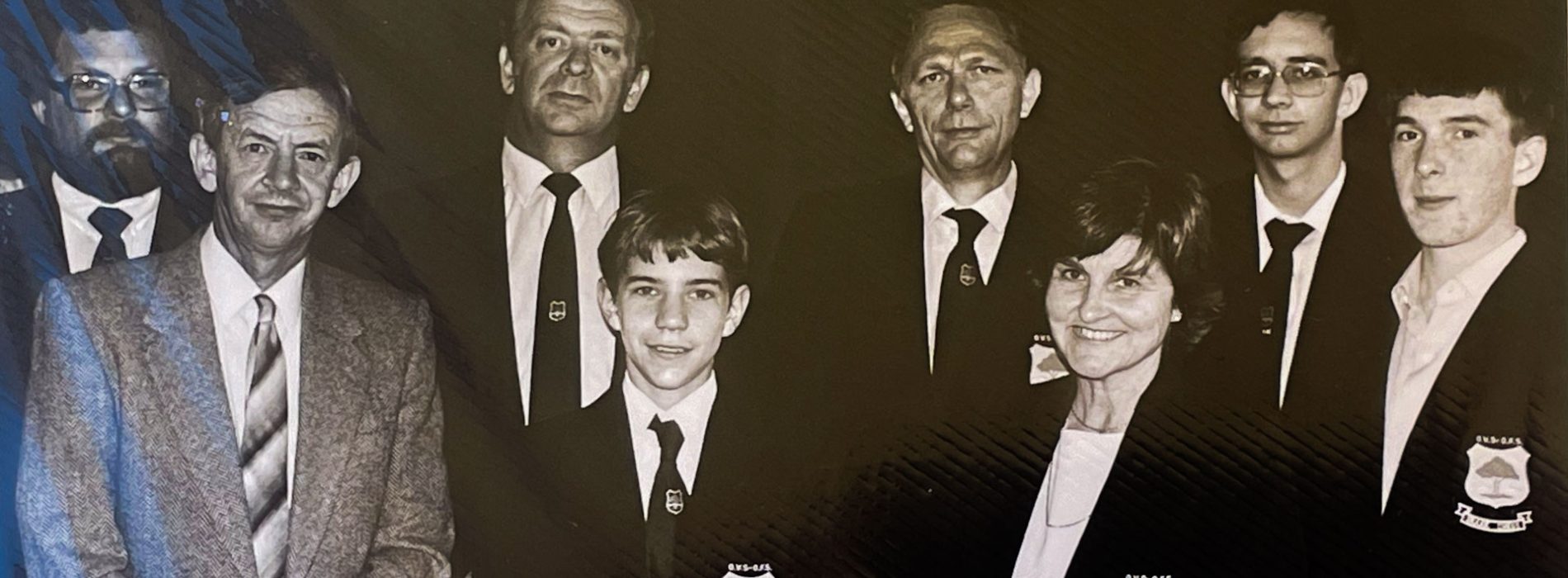
Our move to Pretoria and attending Afrikaanse Hoër Seunskool (Affies) where my Latin teacher, Mr Lebovski, was a South African chess champion and chess was a fairly frequent topic in class also increased my interest. Nearly all the boys in my class had pocket chess sets.
At the Wellington Teacher Training College I had a friend who invited me to hitch hike with him to Worcester his hometown during our holidays. I had my pocket chess set that we started playing while waiting on the side of the road for passing cars. While one was “thumbing” for a ride the other one would consider his next move.
Then, years later, Bobby Fischer a 15-year-old American teenager became the youngest Chess Grandmaster. It was sensational news and the South African newspapers had daily news reports of the games he was playing against the Russian Grand Master Boris Spassky. It was a real revival in the interest of chess and a stimulus for maths and music teaching because it was understood that maths and music scholars often were excellent chess players.
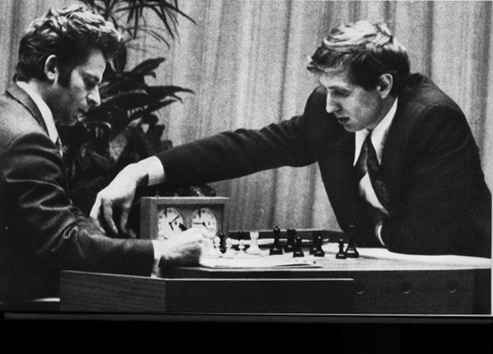
The 1972 World Chess Championship between challenger Bobby Fischer of the United States and defending champion Boris Spassky of the Soviet Union is widely considered the most famous chess match in history. Dubbed the “Match of the Century,” it took place in Reykjavík, Iceland, from July 11 to September 1, 1972. Amidst the geopolitical backdrop of the Cold War, Fischer won the match 12½–8½, breaking 24 years of uninterrupted Soviet domination over the world chess title. Spassky and Fischer remained lifelong mutual friends despite the political hostility surrounding their careers.
I bought a new, larger chess set and started teaching Nikki, who was 9 years old at the time, to play. Colin also showed interest and sat quietly watching as I was instructing her. We also bought a teaching system that has a transparent board allowing the lesson to show through underneath, thereby demonstrating certain moves such as the possibilities for a knight, or how the fianchetto is set up. Michael was too young to get involved and kept an eye on everything from a distance. We did not have television and some of the newspapers printed the match reports of each world championship game daily.
The Fischer-Spassky match was very controversial at times and hogged the news. Because the match served as a massive proxy battle during the Cold War, major mainstream publications worldwide treated the tournament as a front-page geopolitical conflict. We would map out each move on our board, excited to observe the strategies close at hand.
Colin and Nikki would play some games when I was not at home. To encourage their continued interest, I started getting them to practice and memorise the famous chess openings from a booklet that I came across in a shop. They learnt a variety of techniques for attack or defence, depending on whether they were playing black or white.
In those days, we were regularly travelling back and forth between Welkom and Cape Town for the school holidays. Although we always tried to get away early, we often did most of our travelling in the dark. (Often the cat would simply vanish having got wind of the packing, and we couldn’t depart until we had found him!) The radio was a constant companion during the lengthy hours and while I was driving the boys would lean over the back of my seat. Radio connection would frustratingly be lost when we entered the Karoo.
This was a very boring part of our trip, often traversed in silence. On one occasion, I asked Colin to play a ‘blindfold’ chess match against me as we were travelling. He would play with the white pieces and I would play black. This required a good memory, spatial orientation and cognitive awareness as one visualised the move, the position of all the pieces on the board and the colour of the squares. The game between us went on for a while when suddenly Michael popped up and said, “You can’t make that move because the Queen will take it.”
It shocked me that Michael, who was not yet in school and had only casually appeared to observe my lessons, appeared to have a better mental bearing of the chess positions in the dark than Colin or myself. After arriving in Simon’s Town, I came across an advert advertising a youth chess tournament in the Civic Centre in Cape Town. We decided to see if the children could participate.
Early the next morning we travelled to the city centre and Nikki and Colin were entered. Michael was regarded as “too young.” The tournament began and we watched the competitors playing. Some games ended very quickly, so I asked the organiser if Michael could perhaps get a game against one of them.
He clearly did not take the idea of little Michael being able to play chess too seriously, but suggested that Michael could play against his daughter. A short while later I saw Michael standing around and he told me that he had easily won his game. It was after that game that Michael was entered into the tournament as a legitimate participant.
Phyllis and I went looking for refreshments and left the auditorium for a while. When we returned, the tournament organiser and top chess player in the Cape was talking to Michael and when he saw me, he called me over and said that he was amazed at Michael’s chess ability (he had won game after game and was creeping up the ladder!) and implored me to encourage this “rare talent.” The newspapers were in attendance, and the following morning there was a front-page picture of the organiser with Michael on the front page of the Cape Argus!

Returning to Welkom, we discovered that there was a chess club in the basement of the Ernest Oppenheimer Theatre building. Colin, Michael and I joined the club and played matches every Friday evening. Phyllis and Nikki joined the Amateur Dramatic Society and they also met in the theatre complex. (We were fortunate that most national theatre productions visited the city of Welkom and our state-of-the-art theatre.)
Many schools in the Free State offered chess as an extra-mural activity. Phyllis coached chess at Welkom Prep as well as at CBC schools. As our interest in competitive chess developed, we entered tournaments in Bloemfontein and Johannesburg. Our family would book into the hotel, near where the tournament would take place and make a whole weekend of it.
Chess games started to get longer, and matches could easily last for more than three to four hours. Often Michael would ask me what had transpired in my match the night before, because once he started winning his matches more easily, he had time to do other things before going to bed.

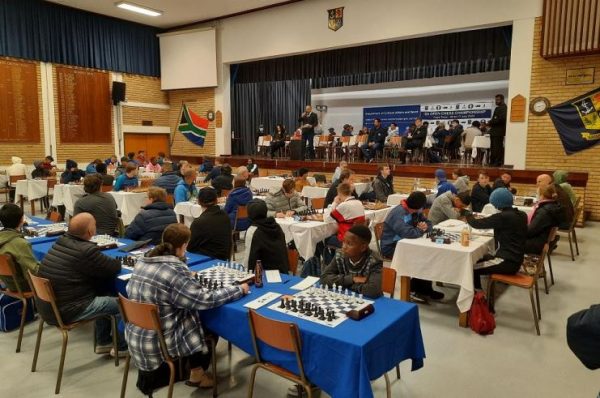
While we were playing in a tournament in Bloemfontein, I was asked to join the Free State Chess Union and soon, at the annual chess union meeting, I was elected to serve on the committee. Phyllis was asked to become a tournament director, so the whole family ended up becoming involved with playing and the management of chess.
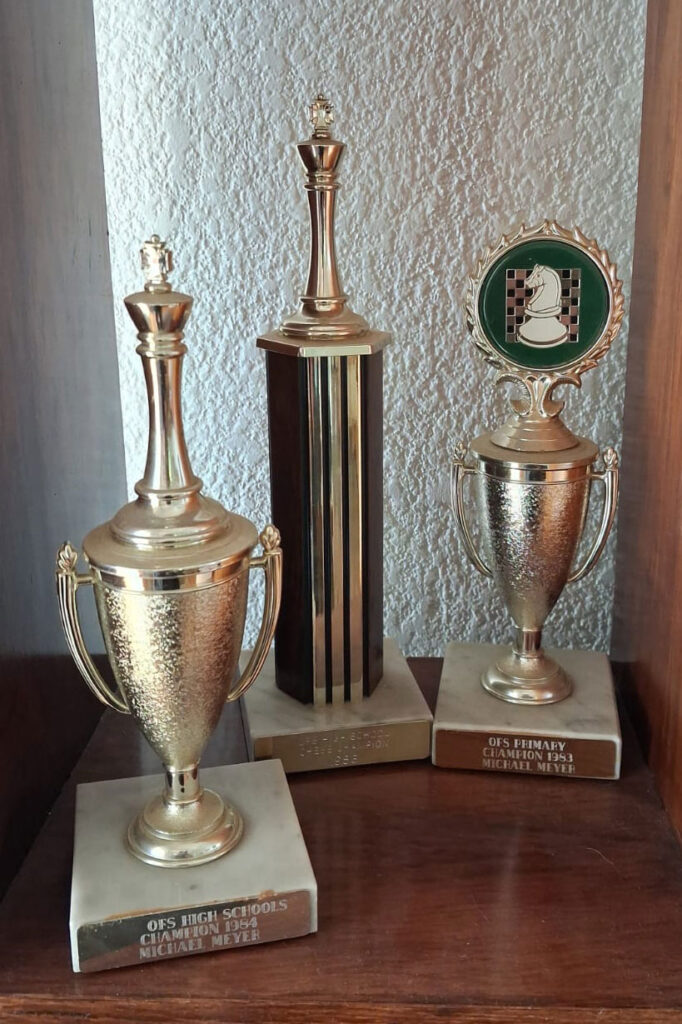
Phyllis would direct the Northern Free State Schools chess tournament and then drive the bus that took the chosen team to Durban or Port Elizabeth etc. It was a great responsibility she took on to care for the team. Colin captained the team and Michael soon became the Board One player. Our chess library at home showed a steady increase and I became president of the OFS Chess Union.

South Africa, at this time, still had a government that followed a race segregation policy also known as “Apartheid.” This quite often placed me in a difficult position because there were many promising black chess players and chess matches were often organised in black schools for both adults and scholars.
Shockingly, when the President of a country like Rwanda visited me in Welkom, I could only entertain him over dinner at the Holiday Inn International hotel – the only non-racial facility in the city.
My Annual General meetings had to be held in the black township of Thabong, where inevitably the venue would be filled with black chess players. On stage we had a mixed committee comprising of myself, the secretary and the treasurer who were white and three black committee members. The people mostly spoke in an African language that I did not understand, but amazingly, somehow, I was re-elected each year.
Chess at that time became a great part of our lives and we would organise and play matches all over the country, including the notorious Soweto township in Johannesburg. I got much of our funding from the taxi organisations because we offered them t-shirts on which their taxi logo was emblazoned. The black townships were safe during the day but we usually were out by 5pm.
Then Michael started school at Welkom Prep where Phyllis was teaching. In his second year we were advised that the Schools’ National Championship would be held in Cape Town. The tournament would end just before the school holidays, so Phyllis, Michael and the Northen Free State team left early for the competition. Colin, Nikki and I would motor down at the end of the term.
Michael, only in Sub B (Grade 2) was entered in the Standard 2 (Grade 4) group as there was no younger category. Without cell phones available to us in those days, we set off on the Friday evening hoping to get to Cape Town before the end of the tournament. As we entered the Cape Town city boundary, we had to adhere to traffic rules so it was gone 12 midday when we entered the back of the hall where the prize giving announcements was taking place and all I heard was :“The Winner of this section is Michael Meyer.” He had ultimately become the South African Champion of his group.
At the start of my 5th year in the Free State, I was promoted to a level 5 position as “Organiser of Remedial Education” in the Free State. This appointment turned out to be quite controversial because the post had not been advertised, so the other Heads of Clinics had not been able to apply. As most of them were senior to me in years’ as well as in experience, it felt a little awkward. However, the Director wanted me to do the job and didn’t entertain any debates. I now had to visit the different Child Guidance Clinics in the province, but it also gave me an opportunity to meet with the black school headmasters and get to get them to start chess clubs in their schools.
During a Schools’ Tournament in Bloemfontein I noticed a well-dressed woman standing near me on a few occasions and I simply assumed that she was a mother of a player. Later I was chatting to her and found out that she was the wife of the Administrator of the Orange Free State and that their son was one of the chess players in that tournament. She invited me to their home for lunch and arranged a meeting with her husband.
I used this opportunity to sound out his perspective as to the possibility of allowing black pupils into white schools during school holidays in order to participate in chess tournaments. He did not have any problem with this, as long as the headmasters agreed.
My next move was to go to schools and ask the Head teachers if we could use their schools and hostels for a chess tournament and in exchange the tournament fees would go towards their fund-raising efforts. (I neglected to mention that there would be non-white pupils participating or staying at the school and the hostel.)
On the opening day, some black schools were first to arrive. When the buses transporting the white players arrived, the bus parked, but the players did not exit. After a while the teachers came over, seeming a little confused, and asked if the other race children were also going to be allowed to play in the same tournament. I couldn’t help myself and commented that black people had always been allowed in our homes but on this occasion they would not need a broom or mop!
Fortunately, things began to change fairly quickly for us and before long the competitors were sharing accommodation as well as bathrooms and showers. We did observe some very amusing incidents during the tournament but I felt satisfied that, on the whole, it was a success and that different race groups could thrive under the right guidance. But unfortunately, elsewhere in the country, restrictions remained the same as before.
Colin captained a mixed-race team to a tournament in Port Elizabeth. After taking his team to the beach for an outing they jumped on a bus to get back to their accommodation. The driver asked the black players to get off the bus. Colin remonstrated with him to no avail, so the entire team exited and walked home. Our team was subsequently supplied with their own bus and a driver for the rest of their stay.


Early one Saturday morning, some of my provincial team and I met in a township near Bethlehem to meet with headmasters of the local black schools. After a discussion promoting the advantages of teaching chess in their schools, we asked if they had their cheque books with them because we had many chess sets to sell to them. They were very happy to get started and it is a well-known fact that if you pay for things, you are likely to look after them.
Once at a National Chess Conference in Johannesburg, one of the members told me that it amazed him that although the Orange Free State was the most pro-Government area because of its race policies, somehow it was the only province that had black members in their chess governing body as well as black players in their chess teams.
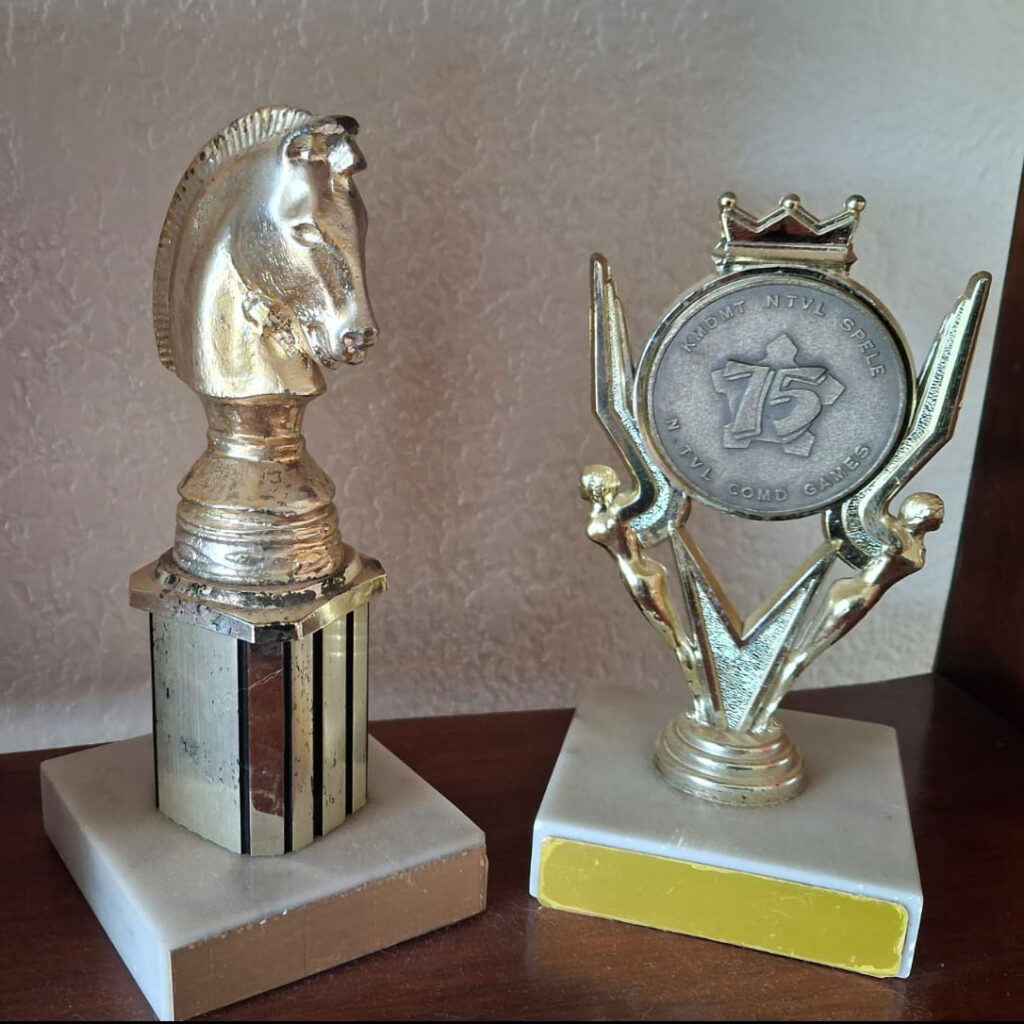
At one stage, Michael, Colin and myself, all played for the provincial team. I am also proud of the honours colours I received for my services to chess in the Free State. Phyllis became a really dedicated and experienced tournament director. She managed everything from the entry process and competition logistics to the complicated seeding arrangements, match pairings, dispute management, tie breaking and then final results for prize-giving and rating purposes. She also vehemently encouraged the school children to play chess.
My role was quite different in that I was responsible for securing sponsorships from corporations such as Pick ‘n Pay, procuring the venues, arranging donations for beverages and alcohol to be consumed at the prize giving function, and in general, being the dog’s body.
Nearly all of the active South African chess players came to our Welkom Annual Chess championship and ended up becoming life-long friends and one or two even offered to coach Michael, our rising star.