

(With special thanks to my father, Jan Meyer, for helping with a rough draft and filling in the blanks to complete this story)
Every kid deserves a wonderful Godfather. Having lost both my Grandfathers before I was even born, Uncle George filled those big boots quite seamlessly for me. When I was a little girl, he and my grandmother (also my Godmother) spoilt me rotten. They took me on outings, weekly visits to my favourite place – the library! And to dine in lovely hotels and restaurants, shopping in the grand old department stores, and to swim and play on the beach.

Uncle George had magic pockets, always able to sneak us kids a sweetie or chocolate. Even as an adult I remember George fishing out a ‘Niki” choccie for me. He was incredibly thoughtful and generous. He’d buy a newspaper for this person and fetch milk and bread for that one. He’d drive someone to Fish Hoek to shop and happily collect them later. A bit of a ladies’ man I suspect as he knew all the single ladies and widows in the area! When I was at university, George would pop over to meet my friends, always bringing a 6-pack to share with the guys and then, after much persuasion, would enthral us with stories about his escapades and close shaves during the war. Uncle George was a favourite.

George was born on 18 March 1914 to Phillip Richard and Wilhelmina Flight. He was one of twin boys and sadly it seems that his brother died at an early age. He told us of how he was orphaned and ended up in a home for children in Durban, before running away to sea. Such a romantic story…
After leaving school he found employment in the SA Railways and Harbours. He told of a bad accident, when the bridge that he was helping to build, collapsed on him, leading him to resign and join the Navy. His records from The Railway Reserve describe him as “Honest, a cheerful disposition and not afraid of hard work. Keen on swimming, soccer and wrestling.”
At that time he lived in Durban. He married and spoke frequently about his son, his house and his animals.

As a loyal naval man, he often spent time away from home – at sea, which proved too much for his wife to bear. George related how, after a long trip to Australia, he arrived home to find that his “marriage had ended”.

Joan Ford had been previously married to Aubrey Davis although the marriage was legally annulled due to Aubrey being found “guilty of adultery” by the British High Court of Justice.
Despite the fact that George and Joan were both non-Catholic, and with a Joan having a documented “civil divorce” from Aubrey; under Canon law, the Flight marriage was annulled, on the grounds that Joan was still married to Aubrey.

He was then transferred to Simon’s Town, which is where he met my Grandmother, Lydia who worked in the Simonstown Dockyard.
George would joke (referring to my French grandmother) that he had been almost fatally bombed by the French during the war and here he was – still ‘under attack’ by them!
Their relationship was more of a companionship than a romantic one from what I observed. They stayed in their own homes – George just across the road from our house in Seaforth – and Gnagna, just down the road in Froggy Pond.
I remember that she would cook for them both every night after which he would sweep and mop the kitchen floor. Then they would sit in companionable silence and listen to Springbok Radio serials. They were very much like an old married couple.


I was amused to come across these police documents amongst George’s saved possessions. My grandmother’s next-door neighbour was called Moxie Frieslaar and he and George seemed to have a lifelong feud. His complaints ranged from fairly reasonable to downright crazy). Moxie complained about George working in the garden (he said that he was offended seeing his rear-end as George bent over pulling out weeds) He was annoyed that when George painted the fence between their homes, there was spatter on his side too. Moxie’s lovely wife Hazel (who was a good friend of my gran’s) would try to mediate between the two of them, but she evidently didn’t get anywhere.

George and my grandmother at a Naval function with my parents, Phyllis and Jan
George was a keen sportsman and played hockey, soccer and tennis and most of all, he loved to swim, spending many hours on the beach and braving the icy cold ocean even in winter. He swam throughout the year, well into his old age. Boulders beach was a favourite haunt due to the protection from the South Easter wind in summer and the charming bathing boxes where many of their friends would gather.
He taught me the excruciating “slap and tickle” method of entering cold water, which I still do not subscribe to, although I always think of him when I’m standing tip-toe in the sea with icicles up to my hips. His approach involved scooping up handfuls of water and slapping them onto his chest and arms before launching into the water. Brrrr!
George made friends all over the country and the world. His many birthday and Christmas cards, letters and photos are all testament to how much he meant to so many people. He was kind, trustworthy and spent a great deal of time in our family home, even living with my mom and dad for a while before I was born.


Uncle George, my grandmother – Lydia, my parents and my mother’s sister – my Aunt Joan and her husband, Uncle Nick, spending a crazy afternoon, making an advertisement for a beer commercial. 🍻
George was a definitive cat-person. I will always think of him, sitting with an ankle across his knee and with a curled-up cat making the most of the awkward space on his lap. His rescued dockyard cats Minnie, Seaweed, Blackie and my grandmother’s cat, Tango, adored him. After my gran passed away, George continued to spend time at her house every evening, keeping Tango company until the old kitty also passed on.
George was a brave and experienced sailor that served in both the Royal and South African Navy. He was reluctant to talk about his war experiences, but during conversations when perhaps a specific battle was mentioned, he might simply say, “It wasn’t like that. I was there.” Being a stoker meant that much of his war experiences were as a member of a ship in action fighting against Germany.

My grandmother and Uncle George on their beloved Boulders Beach
George had a tattoo of a British bulldog draped in a Union Jack which is a classic emblem of naval pride. symbolising courage, defiance, and unwavering patriotism. The bulldog became inextricably linked to the military as a symbol of tenacious resistance during the World Wars.

Piecing together his story has been an interesting and educational journey for me. Firstly from the stories that he shared with our family, secondly from trawling through his naval records, medals and other correspondence and finally researching the actual ships he sailed on and battles that he participated in during his service in the Royal and SA Navies.
George entered the Royal Navy at the most junior engineering rating. As a Stoker II, he learned the physically demanding work of operating coal-fired boilers, maintaining steam pressure, cleaning machinery, and keeping the ship’s engines running around the clock. It was hot, dirty, exhausting work, but it formed the foundation of every warship’s fighting capability.
In 1936, after nearly three years of service, George had demonstrated the technical competence, discipline, and reliability expected of an experienced engine-room sailor. Promotion to Stoker I, recognised that he was no longer simply learning the trade but had become a skilled engineer capable of working independently and mentoring younger stokers.
George’s engine-room service placed him inside some of the most high-stakes, hazardous, and famous naval operations of the entire war. Reading about these excursions made me realise the extreme bravery of the stokers, who had to keep the engines running while blind to the chaos exploding directly above them.
Chronological Service Timeline: George Flight
⚓ The Pre-War Era (1933–1939)
- 31 May 1933 – 28 June 1933 | HMS Afrikander II
- Rank: Stoker II
- Significance: Begins his long naval journey directly at the station in
Simon’s Town.
- 29 June 1933 – 31 Dec 1933 | HMS Vivid
- Significance: Transferred across the Atlantic to the major UK shore barracks at Devonport.
- 1 Jan 1934 – 12 Jan 1934 | HMS Pembroke
- Significance: Brief stint at the Chatham naval base.
- 13 Jan 1934 – 19 March 1934 | HMS Glorious
- Significance: Early career placement on the legendary aircraft carrier.
- 20 March 1934 – 30 May 1934 | HMS Queen Elizabeth
- Significance: Serving in the engine rooms of the historic Queen Elizabeth-class dreadnought battleship.
- 31 May 1934 – 23 April 1936 | HMS Drake
- Promotion: Earns promotion to Stoker I on 1 April 1936.
- 24 April 1936 – 2 July 1936 | HMS Robroy
- Significance: Assigned to a local shore tender unit.
- 17 July 1936 – 27 July 1937 | HMS Cochrane (for Sardonyx)
- Significance: Hard tactical training during destroyer service aboard the S-class destroyer HMS Sardonyx.
- 7 Aug 1937 – 28 June 1939 | HMS Neptune
- Significance: Extended peacetime deployment on the Leander-class light cruiser in the immediate buildup to WWII.
Reading through his service record, it is fascinating to trace the famous ships that he served on, each one worthy of a story in its own right. The pre-war experience is really the “calm before the storm.” George served on massive, legendary capital ships, but left them just before they met tragic wartime fates.
Among the most famous and interesting ships from this pre-war era: George was on board the HMS Glorious (an aircraft carrier) a few years before her famous and catastrophic sinking by German battleships in 1940.
Perhaps this ship is where my favourite story of George’s comes from. He told us about “the mistake” the Navy made of putting him on an Aircraft carrier. He was told to settle down and wait, and that his name would be called. As he recalls “I was nearly court-martialled for not responding to their call”. Turns out that announcements for take off were being made continuously “A Flight; B Flight…so when they called “G Flight” (Flight being his surname), he assumed it was aircraft related. 🤣

One of George’s first assignments in 1934, would have involved shovelling coal and tending steam inside the legendary flagship of the Royal Navy, HMS Queen Elizabeth, arguably the most famous battleship name in British history. She was the lead ship of her class of dreadnoughts, served as the Grand Fleet’s flagship in WWI, and later witnessed the surrender of the German High Seas Fleet.
And then there was his longest sea deployment on HMS Neptune—and a miraculous twist of fate: George spent nearly two full years on this Leander-class light cruiser during the tense build-up to WWII, leaving her just two months before war was declared. In December 1941, HMS Neptune ran into an enemy minefield off Libya and sank. Out of a crew of over 760 men, only one single sailor survived.


Service Record: George Flight
⚔️ The World War II Crucible (1939–1945)
- 29 Sep 1939 – 13 Nov 1939 | HMS Pembroke
- Promotion: Progresses onward to Acting Leading Stoker on 4 March 1940.
- 5 March 1940 – 27 Aug 1940 | HMS Drake
- Historical Action: This critical assignment timeline directly places George on the front lines during the evacuation of Allied forces from the beaches of Dunkirk (Operation Dynamo) in May/June 1940.
- 28 Aug 1940 – 25 May 1942 | HMS Kenya
- Promotion: Rated full Leading Stoker, reaching Acting Stoker Petty Officer (A/S.P.O.) on 27 Dec 1941.
- Historical Action: A massive 21-month crucible. George was aboard “The Pink Lady” during the global high-seas hunt for the German battleship Bismarck (May 1941) and braved the perilous freezing waters of the early Arctic Convoys to Russia.
- 26 Nov 1942 – 7 Feb 1943 | HMS Eaglet (for Malcolm)
- Promotion: Reaches full Stoker Petty Officer (S.P.O.) status on 6 Nov 1942.
- Historical Action: The Algiers Harbor Suicide Run. George managed propulsion below deck as the destroyer leader HMS Malcolm rammed blockaded harbor booms during Operation Torch under intense enemy artillery fire.
- 1 June 1943 – 26 Aug 1944 | HMS Philoctetes (I, II & III)
- Significance: Deployed for over a year on a vital repair and maintenance ship operating out of Freetown, West Africa.
- 27 Aug 1944 – 10 June 1945 | HMS Cormorant (for Malcolm)
- Significance: Formally returns to the crew of the Malcolm operating out of Gibraltar as the war in Europe reaches its conclusion.
George’s promotion to Acting Leading Stoker in early 1940 came just as Britain entered the darkest months of the war. An Acting Leading Stoker, he was entrusted with supervising small teams of stokers during watches, ensuring boilers operated safely and efficiently under combat conditions. It reflected the confidence his superiors had in his leadership and technical judgment at a time when mistakes could cost an entire ship
Confirmation as a full Leading Stoker later that year meant George had proved himself in action. He was now responsible not only for machinery but for the performance and discipline of the men working under him. During operations such as the hunt for the Bismarck and the Arctic Convoys, his leadership helped ensure the cruiser maintained the speed and endurance essential for survival.


Photographs from George’s own album, showing some exciting naval activity
Late in 1941, he was promoted again, this time to Acting Stoker Petty Officer. This was a major step into senior non-commissioned leadership. The role oversaw entire sections of the engine room, coordinated maintenance, allocated duties, and advised engineering officers on the condition of the machinery. The promotion recognised both his technical expertise and his growing ability to lead under the immense pressures of wartime operations.
Promotion to full Stoker Petty Officer in 1942 represented the pinnacle of George’s wartime career as an engine-room sailor. He had become one of the senior engineering ratings aboard ship, responsible for the efficiency, safety, and readiness of the propulsion plant while leading teams of stokers and mechanics. By this stage, he was no longer simply operating the engines—he was helping manage the department that kept the ship alive, earning the trust of both his men and his officers.
In May 1940, Germany advanced into France, trapping Allied troops on the beaches of Dunkirk. Under air and ground cover from British and French forces, troops were slowly and methodically evacuated from the beach using every serviceable naval and civilian vessel that could be found. At the end of this heroic mission, 330,000 French, British, Belgian and Dutch soldiers were safely evacuated.
George had a front row seat to the miracle of Dunkirk and was on one of the ships that famously took part in the rescue of thousands of Allied troops stranded on the beach in France. As a stoker during Operation Dynamo, George’s battle was fought deep below deck, where the relentless heat of the boiler room contrasted with the chaos unfolding above. While the ship waited off Dunkirk’s bomb-scarred beaches, he and his fellow stokers worked tirelessly to keep steam pressure constant, shovelling coal and feeding the boilers so the engines were ready to move at a moment’s notice. Every minute under enemy air attack demanded endurance, precision, and courage, knowing that the power they generated was what carried thousands of exhausted soldiers away from the beaches and back to safety
Personnel from HMS Drake were heavily utilised to man the “Little Ships,” organise the chaotic piers, and staff the destroyers making dangerous runs back and forth across the English Channel under relentless Stuka dive-bomber attacks.
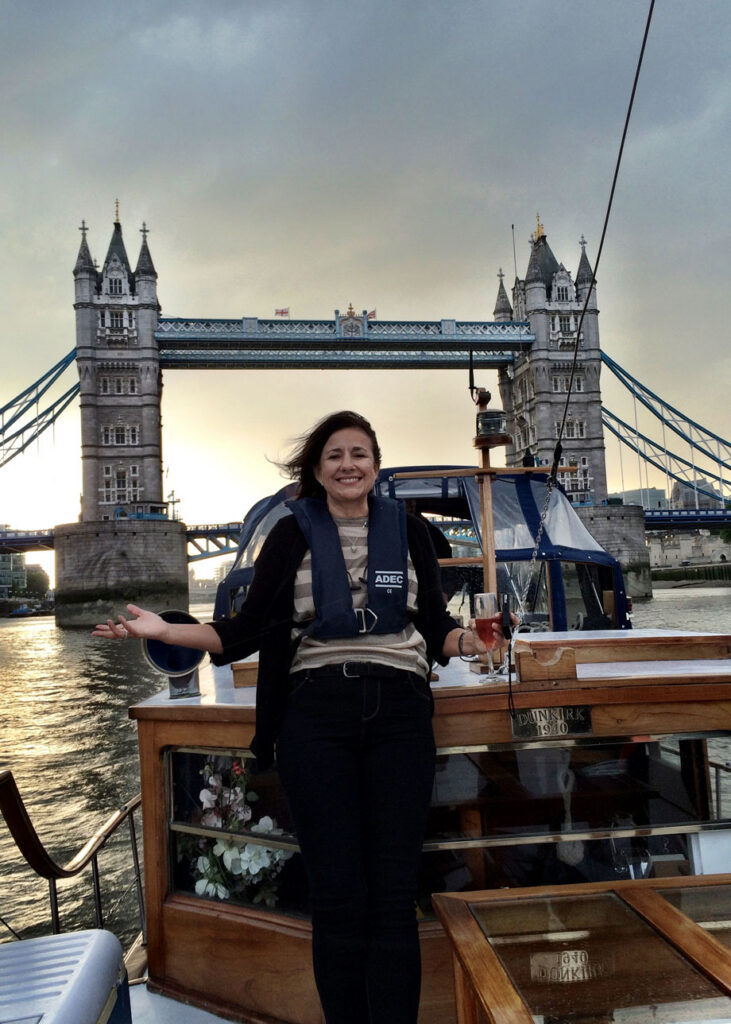
On a business trip to London in 2014, our agency arranged a sunset cruise down the Thames. The little craft that we were on, was one of the boats that participated in the daring and brave rescue of the allied troops. Just below my champagne glass, the brass plaque reads: “Dunkirk 1940”. So very emotional for me to be on this boat and thinking of Uncle George having been there too.
“We shall go on to the end… we shall fight on the beaches, we shall fight on the landing grounds, we shall fight in the fields and in the streets, we shall fight in the hills; we shall never surrender…”
Winston Churchill
“From Dunkirk” by B G Bonnallack
All through the night and in the next day’s light
The endless columns came. Here was Defeat.
The men marched doggedly, and kept their arms,
But sleep weighed on their backs so that they reeled
Staggering as they passed.
Their force was spent.
Only, like old Horatius, each man saw
Far off his home, and seeing, plodded on.
At last they ceased. The sun shone down, and we
Were left to watch along a dusty road.
That night we blew our guns. We paced a shell
Fuse downwards in each muzzle. Then we put
Another in the breech, secured a wire
Fast to the firing lever, crouched, and pulled.
It sounded like a cry of agony,
The crash and clang of splitting, tempered steel.
Thus did our guns, our treasured colours, pass;
And we were left bewildered, weaponless
And rose and marched, our faces to the sea.
We formed in line beside the water’s edge.
The little waves made oddly home-like sounds,
Breaking in half-seen surf upon the strand.
The night was full of noise; the whistling thud
The shells made in the sand, and pattering stones;
The cries cut short, the shouts of units” names;
The crack of distant shots, and bren gun fire;
The sudden clattering crash of masonry.
Steadily, all the time, the marching tramp
Of feet passed by along the shell-torn road,
Under the growling thunder of the guns.
The major said “The boats cannot get in,
There is no depth of water. Follow me.”
And so we followed, wading in our ranks
Into the blackness of the sea. And there,
Lit by the burning oil across the swell,
We stood and waited for the unseen boats.
Oars in the darkness, rowlocks, shadowy shapes
Of boats that searched. We heard a seaman’s hail.
Then we swam out, and struggled with our gear,
Clutching the looming gunwales. Strong hands pulled,
And we were in and heaving with the rest,
Until at last they turned. The dark oars dipped,
The laden craft crept slowly out to sea,
To where in silence lay the English ships.
The hunt for KMS Bismarck
Germany had long sought control over the Atlantic shipping lanes in their road to total victory in Europe. Perhaps the best known of the German battleships was KMS Bismarck which was charged with the destruction of Allied merchant shipping across the Atlantic. A cat-and-mouse game eventually ensued between elements of the British Royal Navy and the Germans that ultimately led to the demise of the mighty Bismarck in May 1941. The Royal Navy responded to German aggression by releasing a hunter-killer task force intended to engage and eliminate the threat posed by the massive battleship. What followed was perhaps one of the most famous naval engagements of the war featuring torpedo-laden biplanes, massive naval artillery bombardments, and extensive use of naval tactics to bring down one of the war’s best known warships. (Source: Secondworldwarhistory.com)

Aboard HMS Kenya—affectionately known as “The Pink Lady” for her distinctive camouflage—he spent 21 months at sea during some of the Royal Navy’s most perilous operations. One week the crew was sweeping the Atlantic in the tense hunt for the formidable Bismarck; the next they were battling towering seas, Arctic gales and the constant threat of U-boats while escorting vital convoys to Russia. Deep in the engine room, every watch meant keeping the ship alive and moving, knowing that a single mechanical failure or enemy torpedo could doom not only their own crew, but the precious cargo and ships they were sworn to protect.
“Mountbatten Pink”: The idea was conceived by WWII British Royal Navy Admiral Lord Louis Mountbatten. He noticed that a commercial vessel painted in a casual grey-pink hue disappeared into the horizon much faster than standard naval ships during dawn and dusk.

Moving from the high-speed chase of the Bismarck, George then braved what Winston Churchill called “the worst journey in the world.” Tending to boilers in sub-zero Arctic waters while navigating ice storms, German U-boats, and Luftwaffe bombers to deliver supplies to Russia is a legendary feat of wartime endurance.
The Royal Naval ships supplied Russia with war equipment as an ally and George spoke of his many trips to Russia as part of the Arctic Convoys. He told of the freezing cold and the iced-in ships in the White Sea and spending time in Arkangel.
(We heard about his Russian girlfriend, Nina, who he met while in Arkangel). George was entitled to the “Russian War Medal” but didn’t bother to collect it. “I’ve got enough”, was his gruff reply when asked why?
The Russian war medal was awarded to recognise the extreme bravery of Allied sailors who participated in the treacherous Arctic Convoys during World War II. Crews from South Africa and the UK were deployed globally. Between 1941 and 1945, these historic convoys sailed through the freezing, U-boat-infested waters of the Arctic Circle to deliver vital food, tanks, and aircraft fuel to the Soviet Union to help defeat Nazi Germany.
While the ship was being hammered by artillery from shore batteries, George would have been deep in the hull. As an S.P.O., his job was to keep the ship moving at all costs. In the claustrophobic, hot environment of the engine room, he had to maintain propulsion despite the chaotic sounds of shells exploding above and the ship violently ramming obstacles.
HMS Malcolm took severe hits, losing three of her four boilers, which cut her speed dramatically and forced her to withdraw. George and his engineering team would have been working frantically in pitch-black, smoke-filled, or steam-scalded compartments to keep the remaining boiler online, saving the ship from being completely destroyed.
To a warship trying to force its way in, these weren’t just blockades; they were literal concrete walls. The Royal Navy formed specialised, desperate “Harbour Clearance” and “Boom Defence” units to break through. Ramming a concrete-and-steel blockade meant charging directly into a choke point at high speed while being completely exposed to enemy artillery and mortar fire from the shoreline. Knowing that George’s ship was the only one out of four to return underscores the devastating casualty rates of these suicide-run port openings.
George explained how hot it was in the engine room and how he just stepped up on deck to cool down for a minute. The next thing the bomb struck the ship and he recounted, “I found myself swimming on the flag deck”. Relatively unscathed, he did however sustain a severe scull fracture when a fellow seaman dropped a heavy hatch on his head. He spent time in hospital but never fully recovered and often complained about feeling “pressure” on his head. His habit of rapidly blinking probably stemmed from this injury.


Wartime accelerated responsibility, but advancement in the navy still depended on competence, reliability, and leadership. His record suggests that as the demands on the Royal Navy intensified, George repeatedly proved capable of taking on greater responsibility, progressing from the newest man in the boiler room to one of its senior leaders before the war was over.
His journey wasn’t just from ship to ship, it was from apprentice engineer to trusted leader, forged in some of the Royal Navy’s most dangerous operations. His career was one of continual growth, with each promotion earned through experience, endurance, and proven leadership under fire.

🇿🇦 The South African Handover (1945–1946)
- 1 June 1945 | Official Military Transfer
- Significance: Page 3 reveals the crucial ink notation: “Transferred to SANF(V)”. He officially steps away from the British Royal Navy framework to join the South African Naval Forces (Volunteer).
- 13 Oct 1945 – 7 Dec 1945 | HMS Forth
- Significance: Post-war service on a submarine depot vessel.
- 8 Dec 1945 – 31 Jan 1946 | HMS Gorgon
- Significance: Deployed on an active transport vessel traversing southern shipping lanes.
- 1 Feb 1946 – 27 Feb 1946 | HMS Afrikander (for Rongoni)
- Significance: George’s British Admiralty career logbook closes permanently as his active records transition fully into the permanent South African naval databases back home in Simon’s Town.
George brought back a piece of black volcanic rock from one of the most famous humanitarian and scientific missions ever undertaken by the SA Navy after the volcanic eruption in Tristan da Cunha.
Tristan da Cunha is the most remote inhabited archipelago in the world. In October 1961, a volcanic cone suddenly erupted right next to the island’s only settlement. The nearly 300 islanders had to flee in a massive hurry, taking only the clothes on their backs. They were initially taken to South Africa by civilian fishing and passenger ships and eventually moved to temporary housing in England.

The SAS Transvaal Mission (January–March 1962)
Because the islanders left everything behind, the British government and the international community urgently needed to know if the island was permanently ruined or if it would ever be safe for them to return.
The South African Navy stepped up. On 22 January 1962, the Loch-class frigateSAS Transvaal sailed out of Simon’s Town carrying a high-stakes, joint South African and British Royal Society scientific expedition.
Here is what the crew of the Transvaal faced and accomplished:
The South Atlantic is famous for its rough seas. The Transvaal battled brutal weather and severe storms, forcing a two-day delay before they could safely drop anchor at the island on 29 January 1962. For seven weeks, the Transvaal remained stationed off the island to support scientists as they braved the active volcanic cone to study the lava flows and determine if the air was toxic.
When the islanders fled, they had to abandon all their animals. The crew of the Transvaal discovered a heartbreaking situation: a pack of 15 domestic dogs left behind had gone wild from hunger and slaughtered roughly 700 of the islanders’ sheep. The crew and scientists had to hunt down the feral dogs to save the remaining 32 sheep, as well as the island’s cattle, donkeys, and geese. The crew inspected the abandoned houses. They found that despite the ash and a year of absolute neglect, most of the homes and the islanders’ personal belongings were still intact.

The report brought back to Simon’s Town by the SAS Transvaal in late March 1962 concluded that the island was, in fact, still habitable.
Armed with this good news, the homesick islanders overwhelmingly voted to leave England, and by 1963, almost the entire population successfully returned home. George and the team directly paved the way for the survival of the world’s most isolated community.

After being decommissioned in 1964, the SAS Transvaal was deliberately scuttled in 1978 in Smitswinkel Bay (just outside False Bay, near Simon’s Town) to create an artificial reef.
Today, it is one of the more famous and beautiful wreck-diving sites in South Africa.
At an average depth of 35 meters, it makes for an eerie underwater experience but due to the depth the wrecks here are only suitable for more experienced divers.


George amassed a number of medals over his years of service for war campaigns, good conduct and long service. The more notable ones are:
- The 1939–1945 Star: Awarded for operational service. The ribbon features three vertical stripes of dark blue (Navy), red (Army), and light blue (Air Force).
- The Atlantic Star: Commonly awarded to Royal Navy personnel for service in the Atlantic and convoy protection.
- The Africa Star: For service in the North or East African theatres. The ribbon is a sand/buff colour with a central red stripe and narrow stripes of dark blue and light blue.
- The War Medal (1939–1945): Awarded to all full-time personnel who served during the war. The ribbon features the colours of the British Union Jack.
- The Africa Service Medal: This is a highly unique South African medal awarded to members of the Union Defence Forces (UDF). The front features a map of Africa and the reverse shows a springbok. The ribbon is gold and green with two distinct orange-red edges.
- The Russian Convoy Medal: Awarded for extreme bravery of Allied sailors who participated in the treacherous Arctic Convoys during World War II.


My memories of my godfather are all about his kindness, generosity and willingness to help others even if at his own expense.
When we think of naval heroes, we often envision captains standing proudly on the bridge, looking out over the horizon. But the true heart of any warship lies deep below the waterline, in the hot, deafening belly of the ship. This is where George Flight spent his war.
As a Stoker Petty Officer in both the Royal Navy and the South African Naval Forces, George didn’t see the incoming dive-bombers or the torpedo tracks heading toward his ship. Instead, he and his team worked in the dark, breathing heavy smoke and battling intense heat to keep the engines roaring. From surviving the desperate beaches of Dunkirk to the high-stakes high-seas hunt for the Bismarck, George helped keep the fleet moving. Working through his journey it seems as though he lived a dozen lifetimes in one.


