
The campsite where we were stayed for a week was very centrally positioned and allowed us the option of using public transport or driving the Bee as preferred. Paris transport is very congested, and I could not, at times, avoid receiving hoots of protest when, to move faster, would slip into the vacant right traffic lane that was reserved for police, ambulances and emergency vehicles. But then I had a Union Jack flag on my back window. 😉
Notre Dame was a must see and one of the first landmarks on our agenda. It is a magnificent building viewed from the outside, but I was rather disappointed with the interior. The huge rose window above the entrance was where most tourist were gathered. I found the other rooms dark poorly lit, so I carried Nikki all the way up the spiral staircase to the top floor where we were able to look outside next to the gargoyle statues that are purported to ward off evil spirits as well as to direct rainwater away from the walls.

Sacre Coeur Basilica is a huge Romano-Byzantine landmark built on the highest point above Paris. The church has four daily masses. The interior is beautifully preserved and all the seats are covered in rich red velvet colour. From its height the view across Paris is outstanding and many groups of people were gathered around pointing out landmarks they identified.
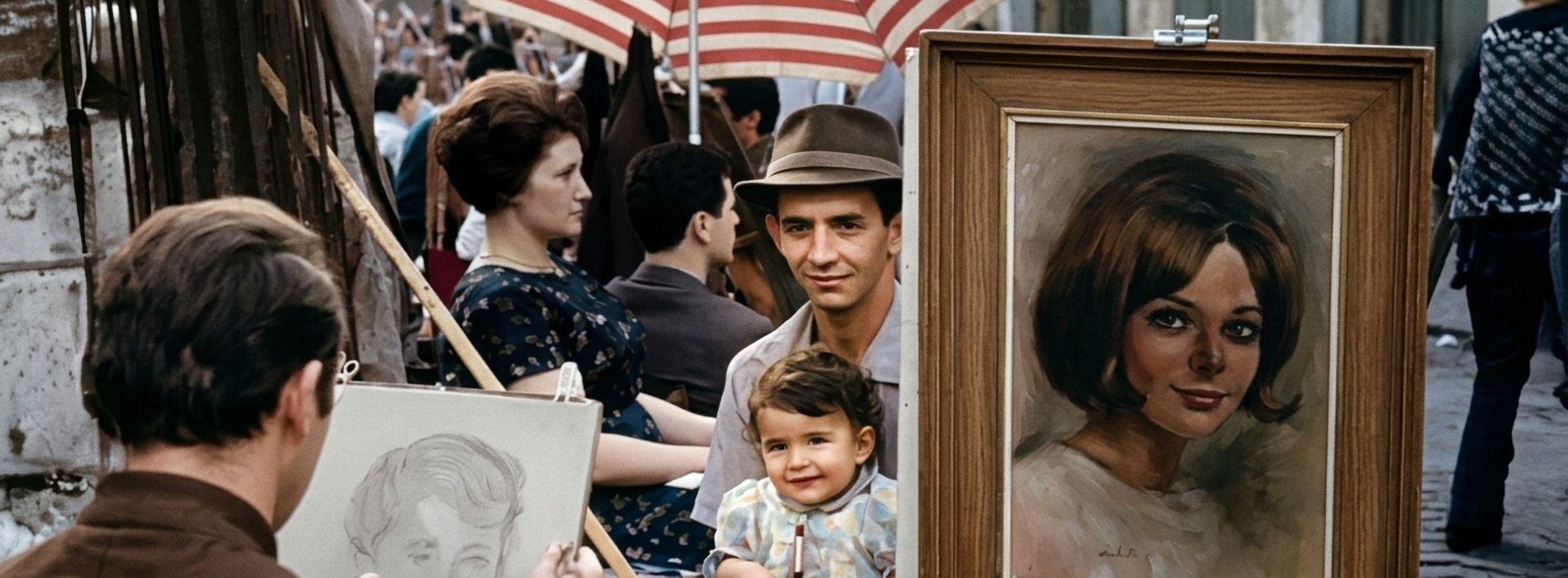
Place du Tetra a large square filled with portrait sketchers and artist. We started by walking around and looking at all the work underway and the style of the paintings. When one artist asked Phyllis to pose for a sketch she suggested Nikki as a model. I had to sit holding Nikki fairly still on my lap for quite a while. After it was completed we liked it very much, so he also made a sketch of Phyllis. We had both framed when we got home.
The Eiffel Tower was a must see, and we could drive fairly near to the tower at that time. We found ourselves surrounded by hundreds of foreign visitors. I was particularly impressed by its size and the solidness of the construction and could not understand that such a structure was merely built for an agricultural show and was intended to be broken down after the event. Fortunately war had broken out and it was able to be used by the military. I remember standing in the middle beneath the tower, staring upwards. Nikki wandered happily amongst the people and we had to hunt for her a few times. The first stage was open and free, so we spent time viewing Paris from that level. They were busy installing a lift in the right leg of the structure at that time.
The summer weather in France is different to what we were used to in that the sun sets much later. One evening after having busily cleaned and cleared everything in preparation for our next trip, we suddenly realised that Nikki was missing. We rushed about searching and calling her and eventually located her playing soccer with the children of other campers. It was nearly 10.00pm. She seemed to be enjoying herself and had made friends for future playdates. Since the camp was on a little island on the Seine with reasonable security, we felt that she was safe playing with the other campers’ children.
Chateau de Malmaison is the Palace Napoleon had built for Josephine and is about 8 miles outside Paris. Napoleon hated that his every move in Paris was being watched so he had this private love nest built for Josephine. The garden is advertised as a “gardener’s dream” and the Palace was still much like it was in their day. Josephine died there.
We arrived before the Palace was open to visitors. I reversed the Bee next to the sidewalk and we started making breakfast. A young couple parked close to us and we started chatting. The man told me that they had come a long way to Paris. I asked where they came from and he said, “South Africa.” I asked where in South Africa and he replied, “Cape Town”, and then “Wynberg.” I told them that we were from Simon’s Town. What a coincidence!
When the Palace was open we entered a most beautifully kept garden. The maison was also absolutely beautifully kept almost exactly as it was in their time we were told. The luxury they had then was amazing. We saw the room where Napoleon often slept. It was quite plain and had a wooden floor.
We visited the Arc de Triumph and Avenue des Champs Elysées street together. The Arc de Triomphe is a massive French national monument built by Napoleon to celebrate his victories and it honours fallen soldiers in battle. It is huge and there are staircases for visitors to go to the top for a panoramic views of Paris. Afterwards the three of us took a leisurely stroll down the Avenue and admire the shops and unusual buildings.
The Louvre Museum is the world’s largest and most-visited art museum with about 35,000 works of art. To make the most of our time inside we had to plan well. Nikki’s push chair, my tripod, water, food etc., all had to be carried. There were must see works such as the famous Mona Lisa which had just been returned from Washington D.C. where it had been on show from 1963-1964.
The Louvre Museum has 3 wings; Denon, Sully and Richelieu but in 1965 Richelieu was not fully part of it. There are also three levels. The Egyptian treasures were mainly at the bottom floor. The exhibits were displayed in huge rooms or chambers with seats in the centre and exhibits on the sides so you could sit and study a painting at your leisure.
The Mona Lisa was of interest to me. Visitors were allowed quite close to it. It was positioned at face height and behind fairly thick glass. I took out my tripod and pulled each leg to extend them. Suddenly a museum guard charged into me and physically pulled me to one side. I did not understand his language but it turns out that as I was extending the tripod legs one pointed in the direction of the Mona Lisa painting and the guard thought that I wanted to damage it! I was eventually allowed to place my camera and take my pictures.
Next we went down to the Venus de Milo sculpture. The challenge here was that with its return from America and the extensive publicity, many wanted to see the statue. There was not enough space to accommodate taking a picture without having someone else included in the picture. The bottom chambers were packed with Egyptian artifacts that could be worth an exhibition theme on its own.
At that time there was also an exhibition of Dutch masters on loan from the Soviet Museums. The central benches in the viewing halls were well occupied by visitors wanting to study the paintings. We were more interested in works from Pablo Picasso, Rembrandt, Vincent van Gogh and Vermeer such as Night Watch, The Girl with the Pearl Earring and “Starry Night” etc.
It took quite a long time to study each painting and we noticed that Nikki had fallen asleep on a soft bench in the middle of the hall. We could keep an eye while she slept and slowly the crush of visitors started diminishing. We had the opportunity to observe the paintings at close hand while she slept peacefully.
We wanted to go into the next hall but did not want to wake her. As soon as the hall was clear of visitors we sneaked round the corner into the next chamber, leaving Nikki sleeping peacefully. I do not know how long we were away before returning only to find that Nikki had gone. We immediately panicked and started dashing around to find help and alert the security.
Far ahead I saw a couple with Nikki walking ahead. It was an America couple who said that when they saw this little girl they thought that she was left behind or abandoned. They were relieved to hear our explanation. We knew that we would not be coming back to Paris soon so we tried to pack in as much as time allowed.
Unfortunately, all good things come to an end and we had to get to England, sell the Bee, go back to Southampton, board the Stirling Castle and back to South Africa.
Although the distance between Paris and London is only 290 miles, in 1965 it was still a 4 to 5 hour journey because there were no motorways then. We decided to make it in two days because the route passes directly through the historic battlefields of Picardy and Artois. We visited some WWI cemeteries and Poppy fields. Poppies bloom in May to June each year making the countryside a beautiful scarlet when looking from afar.
Arriving in Calais before lunch and crossing the Channel in the afternoon meant that we reached the Overseas Visitors Club in good time to settle in.
