

After his scary, jaundice diagnosis and brief treatment after birth, we were able to bring home a beautiful, healthy boy. With his blonde hair, blue eyes and smiley face, Michael was the apple of everyone’s eye and whenever he was awake, he had our full attention. He was a strong baby and early to crawl. Nikki spent every free moment with him and Colin was keen to help him stand up and participate in ‘boy things’ even before he was ready.
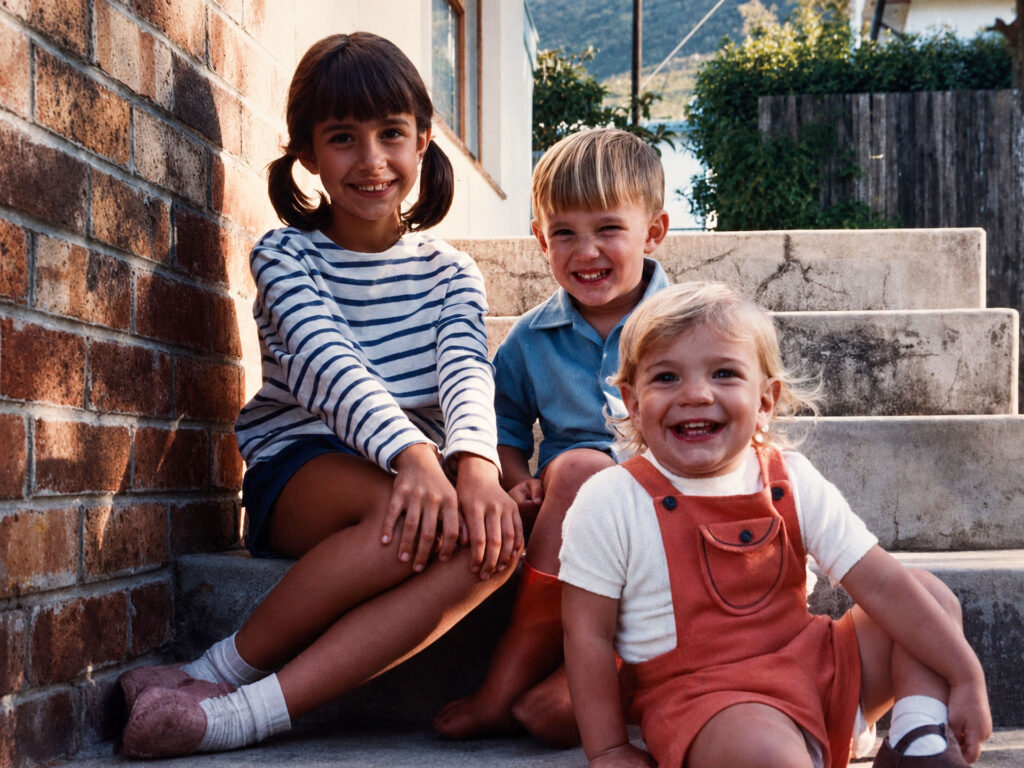

Michael’s growth and development was very “normal” according to the nurses whenever he was taken for a checkup. What I especially remember was that the girl’s in the family loved his long, curly, blonde locks and I just could not get them to have it cut. He got mistaken for a girl for a while.
If I recall correctly, he could walk at about eleven months. Colin, only 18-months older, could not wait for him to grow up. I discovered that he had managed to lift Michael onto his old tricycle encouraging him to put his feet onto the pedals and getting him to pedal way before he was really in control of the trike. Luckily Mikey (as we called him) was quite brave and fearless.
Michael was a big boy when his first haircut was attempted. Nikki was so excited as I remember. She took charge of the event, and I had to take pictures and even a movie of this special occasion. Phyllis did the cutting and hair samples were collected, stored and shown to granny. Nikki was quite heartbroken that her blonde ‘doll’ now looked like an ordinary little boy.
When Phyllis was needed for a teaching post, Colin and Michael had to be dropped at a day care centre close to Gna-gna, who was delighted to have them to stay with her after hours. We always had to remember that the boys had to have shoes when they went to stay with her, or else she would demand: “Where are these children’s shoes?!”
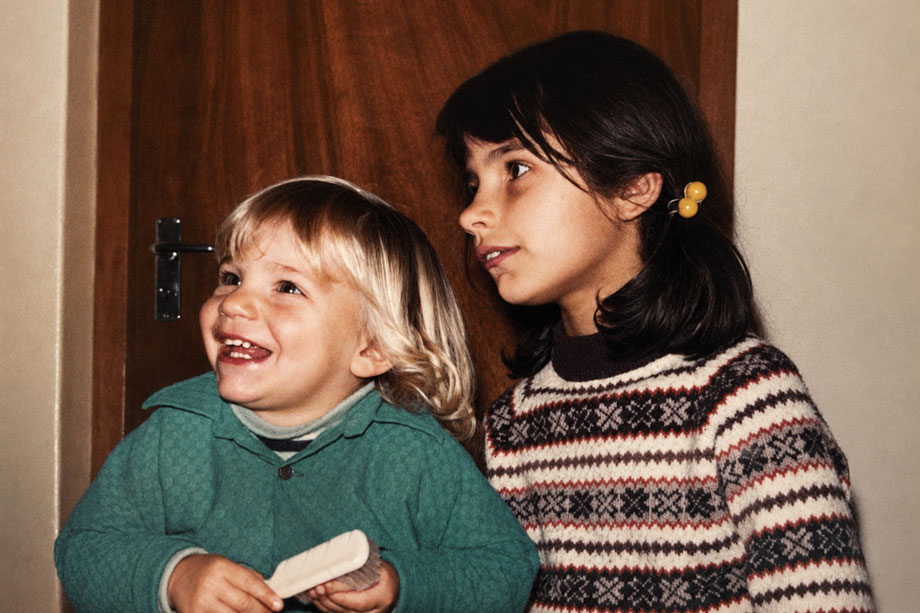
From an early age, Michael was rather stubborn, for example, he insisted on dressing himself and we had to wait for him to put on his own shoes, which could take ages. I remember going to fetch him from granny on one occasion and as she opened the front door she said, “Take Your Child.” I was quite shocked by her change of attitude towards Michael. It turns out that he went to play in the garden and came back with bare feet because it was hot and he hated shoes and refused to put them back on again.
Gnagna went out looking for the shoes and despite hours of searching could not find them. It took me some time before I found them on top of a hedge. On another occasion, Uncle George and Gnagna took the boys with them in the car to visit some place. Michael disgusted that he was forced into a pair of shoes again, tossed them out of the car window while they were driving.
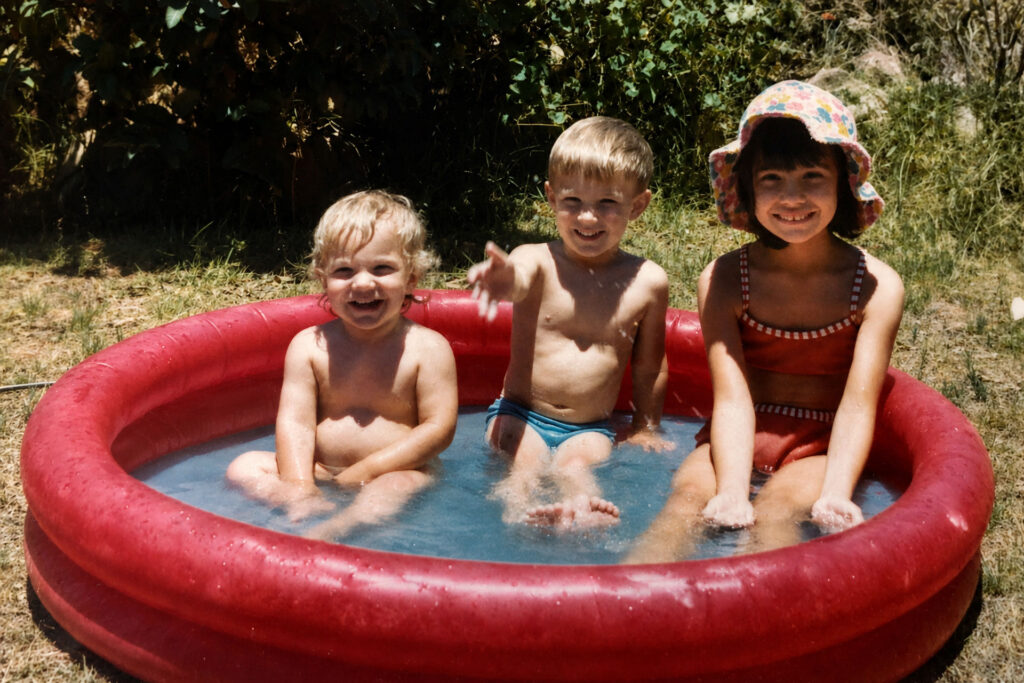
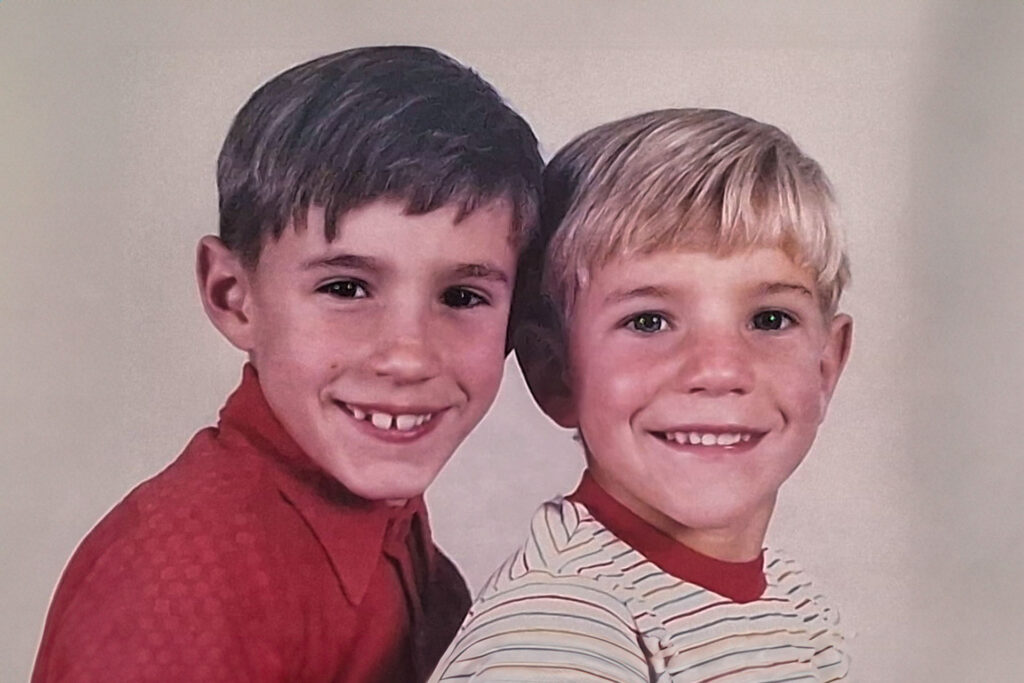
Whenever he was hot, he undressed immediately. I remember once when we were at the airport waiting for a relative to arrive, we were sitting around a table when Michael suddenly stripped off his shirt and refused to put it on again. That is not what nice French boys do. That was amusingly similar to how I spent my early life on the farm so it did not bother me.
When we moved to Welkom, Michael started attending a nursery school. The principal called us in because he refused to conform at rest time. What she really wanted to tell us, I think, is that he was a bit stubborn and did not obey instructions or rules like the other children.
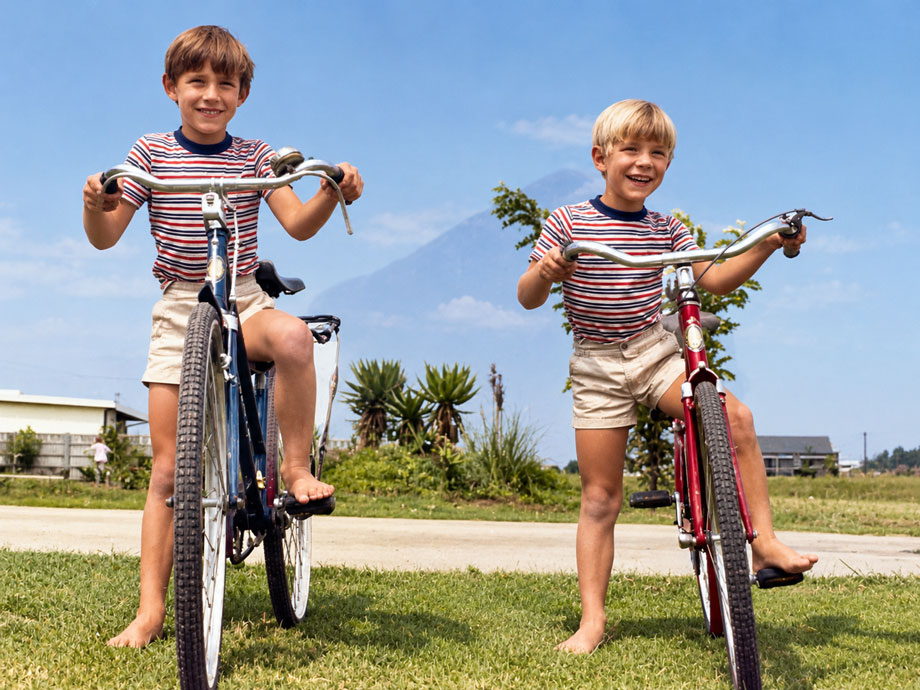
The boys enjoyed riding their bicycles over the weekends because the roads had little traffic in our new suburb and the weather was generally favourable. On one Sunday afternoon, a man knocked on the door, claiming that Michael had crashed into his car and demanding that I pay for the damages caused. Michael arrived and confirmed that he had fallen against the car but was uninjured.
Shortly afterwards when Colin returned, I questioned him about what had happened. He told me that they heard the car behind them and that he had moved over to the left and Michael had moved to the right, allowing the car to pass through the middle. That was when the accident happened. I remembered that there was a light rain shower at that time. We went to look at the site and could clearly still see the bicycle and car tracks.
I discussed the incident with the chief public prosecutor who pointed out that the law requires a car to hoot as a warning to cyclists and has to pass on their right side and not the left one. This meant that I was not legally responsible for any damages to the car.
Once Michael started school at Welkom Prep and became well known as a strong chess player, Phyllis mentioned that when they arrived at school in the mornings his classmates would warmly wave at him in welcome, but that he did not respond or show any reaction.
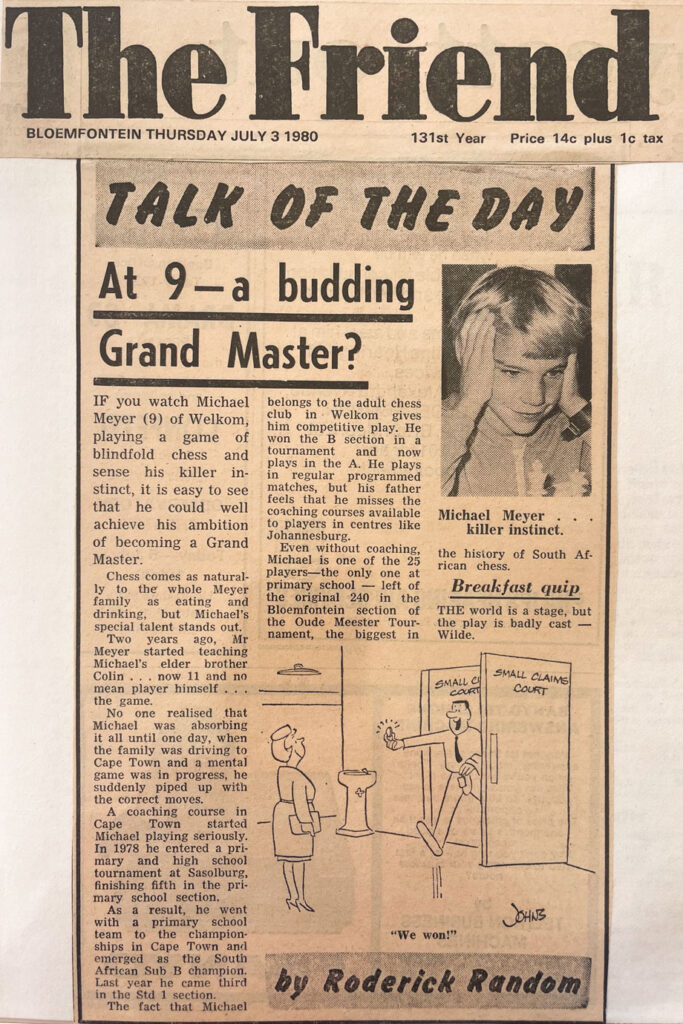
Michael, at a very young age, showed a remarkable ability to memorise and understand spatial chess moves without a cue of any kind, like when he drew our attention to a mistaken move in a blindfold chess game while we were driving to Cape Town. He won the South African grade 4 national championship when he was still in grade 2.
However, what changed my whole outlook about Michael’s future as a chess player was an incident one Sunday evening in Welkom. We attended evening Mass at that time and were in the car to go to church when I realised that Michael was missing. We called and I hooted but he didn’t show up. I then went into the house to see why he was not joining us. He told me that he was listening to a chess game being described on the radio and it was nearly over and he would be coming very soon. We were almost late for church.
His keenness to listen to a chess game over the radio was to my mind something exceptional, but what happened next changed everything. After mass we took our time to go home, chatting to people and having some refreshments, when Michael called me aside with a small chess set in his hands. He said that he wanted to show me the game he had been listening to over the radio before we left for church.
He quickly placed the white and black pieces on the board and proceeded to replay the whole game that he heard on the radio right to the last move. I was truly dumbstruck because I did not think it was possible, especially by a primary scholar who had only learnt to play chess a few years earlier.
It instantly became my duty to provide him with every opportunity to develop that God given talent that I observed that night. It is a parent’s duty to try to recognise and develop their children’s talent, but it is usually not that obvious, nor so early identified, as it was in Michael’s case. From then on, I bought any chess book he recommended and took him to play in as many chess tournaments as possible.
Colin captained the Northern Free State’s team and consistently played Board One. He won as many trophies as Michael. He was chosen to participate in a mini tournament in Bloem to select the ten best high school players of the province. Unfortunately, he contracted mumps and the Free State had to find a replacement. I suggested Michael to take his place, even though Michael was then only in grade 6.
The tournament wanted to find the best players so a round-robin format, in which each player must play every other player, was adopted. I dropped Michael off in Bloemfontein and went home. Later the results were made available. Michael who did not qualify to play in the high school tournament had beaten every opponent he faced.
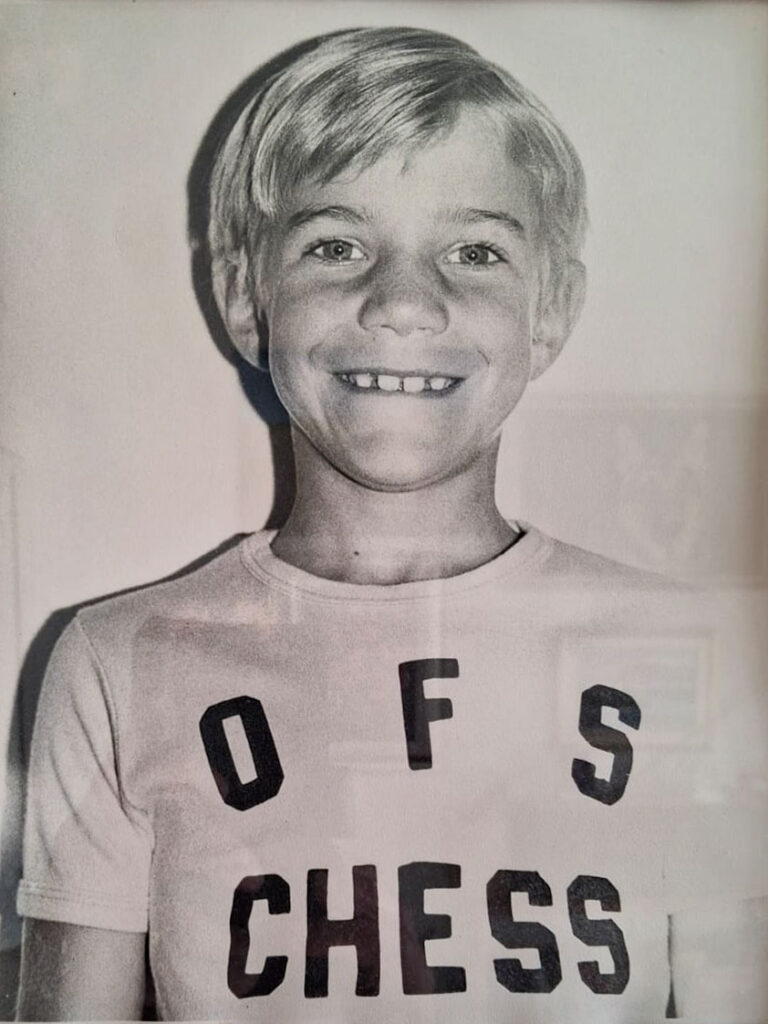
The three of us played chess for the Free State team during which period we played some inter-provincial matches. Michael moved up in the board rankings and eventually was playing board no.2, ahead of Colin and myself.
Once at a tournament Michael asked me who I was playing against. When I told him that I was playing against Professor Heyns he said, “I’ll show you how I beat him.” After he showed me the moves I asked him when this match had happened. He said, “Three years ago.”
I tried to get him to play in serious competitions as frequently as possible.
Later when he was entered for a tournament in Durban, we had to send him on his own. His name was pinned to his shirt (as an Unaccompanied Minor) and an air hostess would look after him during the flight and a chess parent or official who would accommodate him for the tournament would collect him and would be responsible to look after him and arrange the return connection to Bloemfontein, where we would collect him again.

He did not always like to be away from home for so long but enjoyed the advice and adult chess tips and teaching he got for free as part of the exposure.
In the next National Chess Championship Michael, playing in the next higher division again, once again became the South African champion by winning this section.
Chess computers were becoming more popular as time went by and also more infallible. My first encounter with one was at a tournament in Johannesburg. I drew with the computer in my first round and then happened to win in the second but was told that because it was a Friday evening at the end of the month, the city computers had used so much power that it was a “weakened opponent” I beat.
New improved chess computers were being imported, and I bought one to use at home and later an even more advanced one that had a teaching facility.
Then a national announcement was made to find the South African scholar that would be the fastest to beat a brand new, sophisticated computer. The prize was a Study Bursary in the USA. Young chess players from all over the country started registering and playing to win this incredible study prize. Michael was one of them and had to do quite a bit of travelling to eventually emerge as the Free State winner.
Later it was announced that “a Grade 12 pupil in Cape Town would play against Michael Meyer grade 6 from Welkom in the Free State”. It took some time before the venue was announced. It was to take place in a coffee shop in Church Street in Pretoria on a Saturday morning. The format was to be a blitz game. FIDE rules applied, which states that a player immediately loses if their time runs out.
We left Welkom early in the morning so that Michael could rest before the match that would start at for 12h00. We located Church Street and started looking for the coffee shop. It was surprisingly small with not much room for spectators. His opponent was a tall young man of about 18 years old. Michael’s feet did not touch the ground, and it really looked like a mismatch.
The rules were explained to both players and the clock was set for a 10-minute duration. Both players played carefully and from what I observed, it remained quite even in position and the number of captured pieces. As the game progressed, the moves became more intense. The time on their clocks also remained roughly equal. Then with about one minute left it became a real game of blitz, with their hands flying between the pieces and the clock. Michael’s opponent’s flag fell first, which meant that Michael had won the match.
My sense was that the result was seen as an anti-climax by the spectators, because no one really expected Michael, as the youngster and under-dog, to win. The loser left quite abruptly. The adjudicator said that he would report the match result to the organisers, and they would inform us with their final decision.
We waited some time for news from the organising body to be informed that Michael was too young to qualify for a study bursary in the USA and therefore the prize was awarded to his opponent. We were very proud of Michael, and it again showed how talented he was.
Two chess grandmasters toured South Africa, and both came to Welkom for exhibition games. They would play against 10 opponents simultaneously in a match. They defeated every player except Michael, who drew with both chess grandmasters. They were very impressed with him and presented him with their autographed books.
I spoke to the manager of Pick ‘n Pay and organised that we arrange tables in the mall for 10 players outside the store to play against Michael. Pick n Pay would sponsor and display the prizes that could be selected from, by anyone who could beat him. As he walked from table to table to make his next move, we eventually agreed to let losers pick a prize because no one was able to beat him.
I saw Michael play blind-folded against two players simultaneously and beat them both easily. One evening a university student who was an excellent player joined us for dinner. He and Michael started a blindfold game before we left for the restaurant, paused for a bit while we ate, and then continued the game on the way back home.
